Apr
10
2009
“And you teachers, go on teaching the young the ways of God. In these days the State is giving them secular instruction all the day long, six days in the week; and religious teaching is greatly needed to balance it, or we shall soon become a nation of infidels.”
– C. H. Spurgeon (1834-1892)
Comments Off | tags: Spurgeon | posted in Quotes
Apr
10
2009

Whether you know it or not, as you flip through a magazine, or peruse a Christian bookstore, the big question on loop in your mind is “What’s in it for me?” In a culture where an advertiser or publisher has only seconds to grab your attention, there has to be a visual hook. Magazine articles hit us with one big photo, knowing that if they sell us with that, we’ll read the fine print. A book, right down to its spine, has to say “Pick me because…” For the world’s Vanity Fair hucksters, the aim is to wave a stunning flag at all costs. It doesn’t even have to be for the right country. Anything goes as long as they draw a crowd.
Continue reading
Comments Off | tags: Biblical worldview, Culture, Doug Jones, Protestantism | posted in Christian Life
Apr
10
2009
“…the historic Protestant Church must reassert her prerogatives with regard to keeping the oracles of God. The rights to market the Bible were not sold by the Holy Spirit to Rupert Murdoch, the current owner of Zondervan. How in blue blazes did Mammon get the publishing rights to the Word of God? Who was involved in the transaction, and why hasn’t he been publicly flogged?”
– Doug Wilson, Mother Kirk, p. 59-60.
Comments Off | tags: Doug Wilson, Protestantism | posted in Quotes
Apr
10
2009

“…the coming of the kingdom means that the saints are, in Christ, seated in heavenly places, enthroned in fulfillment of the dominion mandate. Heavenly dominion over sin and Satan is the basic form of dominion for the individual Christian. But the Bible teaches that the saints have dominion over earth as well as heaven (Rev. 5:10). Heavenly dominion is over “spiritual forces of wickedness in the heavenly places” (Eph. 6:12), but by exercising this heavenly dominion, the church rules also on earth. The rule of the church over the demons is not only subjective and spiritual, but has objective historical consequences.
Continue reading
Comments Off | tags: Compromise, Holy war, Peter Leithart, Postmillennialism | posted in Biblical Theology, Ethics
Apr
10
2009
The Old Testament surely has a measure of built-in obsolescence. But it is the obsolescence of childhood. The New Testament, the Covenant of the Man, cannot be truly understood without a detailed knowledge of the Old. A friend posted this quote from Rudolph Bultmann: “who went on to cast a large shadow of influence over 20th century theology. Bultmann argues that the whole Old Testament narrative is of no importance to the Christian faith.”
Continue reading
1 comment | tags: Biblical worldview, Bultmann, Church History, Gnosticism, Hermeneutics, Peter Leithart, Philosophy, Typology | posted in Biblical Theology
Apr
10
2009
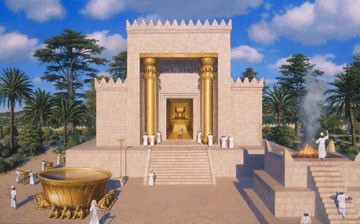
When Solomon’s Temple replaced the Tabernacle, everything was more glorious. Among the enhancements and additions were two great bronze pillars at the entrance. One of the things the Tabernacle symbolises is a great metal man. The glorified Christ is seen in visions with legs of molten bronze, or a fiery, angelic stream that reaches down to the Altar of the earth. The Tabernacle was a portable ‘flying’ chariot of God. These two great pillars, priest and king, were its landing gear.They pictured the union of heaven and earth, and Jew-priest-Land and Gentile-king-Sea in Christ, Greater Solomon.
“I saw still another mighty angel coming down from heaven, clothed with a cloud. And a rainbow was on his head, his face was like the sun, and his feet like pillars of fire. He had a little book open in his hand. And he set his right foot on the sea and his left foot on the land…” (Revelation 10:1-2)
Comments Off | tags: Revelation, Tabernacle, Temple, Typology | posted in Biblical Theology
Apr
10
2009
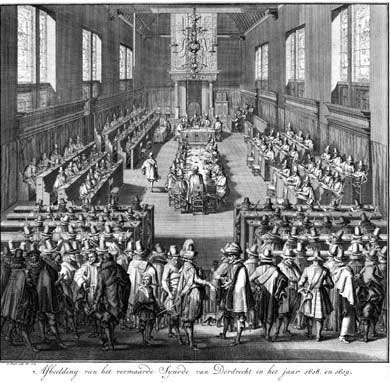 The Synod of Dort
If you’ve ever been to a Synod, you’ll quickly find out that “truth” is determined by numbers.
So remarked a Catholic contributor on a Protestant forum recently. Is this a fair criticism of Protestant disunity? How should we Protestants reply? Thanks to James Jordan’s teaching, I think I can offer an answer.
Continue reading
Comments Off | tags: Church History, Communion, Mass, Priesthood, Protestantism, Roman Catholicism, Synod | posted in Biblical Theology
Apr
10
2009
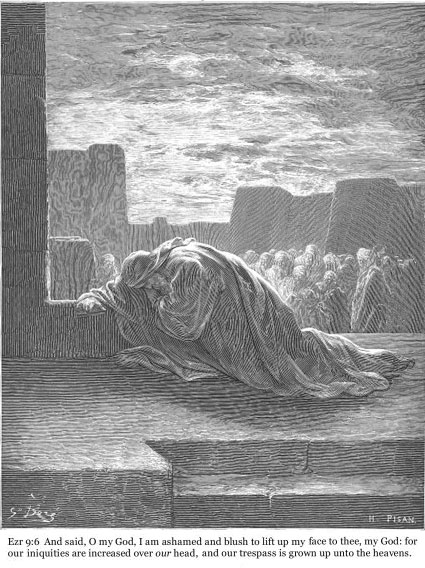
Ezra took a great risk to bring Levites and riches to the Temple from Persia. Mixed marriages were suddenly of more concern, which poses a difficult question. Things seem to be heading backwards—away from the New Testament rather than towards it.
Continue reading
Comments Off | tags: Ezra, Nehemiah, Peter Leithart, Pharisees, Priesthood, Resurrection, Tabernacle, Temple | posted in Biblical Theology, The Restoration Era
Apr
10
2009
Why are females baptized?
The Bible begins with the entire physical creation in view and works its way down through a Covenantal ‘world’—Adam-Israel (the blood of circumcision)—to Jesus, in whom the entire old world is slain and resurrected. The Bible then works its way out again through a Covenantal ‘world’—Eve-Israel (the water of baptism)—to a totally redeemed physical creation at its end.
Comments Off | tags: Baptism, Covenant Theology | posted in Biblical Theology
Apr
10
2009
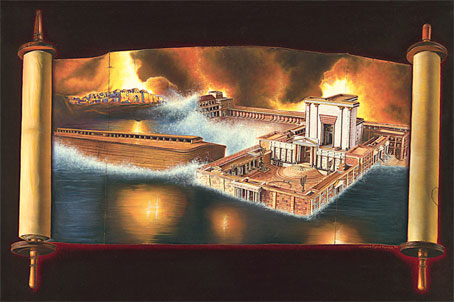
A couple of guys have written a book called Beyond Creation Science. As preterists, they understand there was a symbolic ‘flood’ across the Land of Israel under both Nebuchadnezzar’s Babylon and Nero/Vespasian’s Rome. Problem is, they read this back into Noah’s flood and try to say that this was only a local flood, which then allows them to compromise with old-earth Creationism.
It was ‘long-age’ geological assumptions that provided a ‘foundation’ for Darwin’s long-age biological fantasy. I would recommend Tas Walker’s site, Biblical Geology, for someone who really knows his stuff.
The position of these fellows causes more problems than it fixes. It makes the Bible’s very detailed chronology a joke, and forces a gap of millions of years into Genesis 1.
Here’s the solution:
Adam’s failure brought physical de-Creation. Cain founded a corrupt civilisation whose evil influence triumphed and was destroyed in a literal flood. Just like Cain, Ham was cursed, and his son Canaan’s influence led to social de-Creation. As God raised new land out of the waters after the flood, God would now perform another Creation miracle. In calling Abram, God was socially dividing the waters of the nations into the Land and the Sea. The era of the patriarchs, ruling fathers, began. God called Abram, and tore the world in two.
The land and sea division was a literal, physical land and sea in early Genesis. The ark of Noah was a literal ’world-in-a-box’, a safehouse and doorway to a new world. But when God called Abram, the ‘Land and Sea’ division was purely social, and the Tabernacle and Temple were a symbolic ‘world-in-a-box.’ These guys have confused these two and unwittingly undermined the authority of Scripture.
[Also, on hyperpreterist ‘Covenant Creationism’, see A Chronic Hysteresis.]
Comments Off | tags: Abraham, Against Hyperpreterism, Bible Chronology, Covenant Creationism, Temple, The flood | posted in Against Hyperpreterism, Biblical Theology, Creation, The Last Days