Apr
11
2009
Living in the beautiful Blue Mountains, for exercise, I walk a lot. Keeping a diary last year, I just calculated that I walked over 900 kms.
Walking is when I do my best listening and thinking. Thank God for an iPod, an mp3 Bible and James Jordan lectures. His series on Revelation took me a year in 2007.
900kms (or 204 lectures) might seem a lot to get through, but you know what they say about eating an elephant.
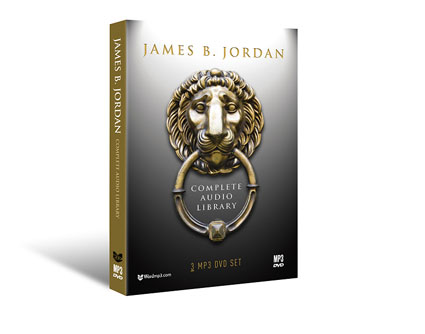
All Jordan’s lectures are available in one package here. I must say, they also have a very attractive cover.
Comments Off | tags: James Jordan, Revelation, Wordmp3 | posted in Biblical Theology
Apr
11
2009
A worship service should follow the seven-fold Covenant pattern:
Call to Worship (Genesis – Sabbath)
…..Confession of Sin (Exodus – Passover)
……….Ascension of Praise (Leviticus – Firstfruits)
……………Teaching the Word (Numbers – Pentecost)
……….Offertory (Deuteronomy – Trumpets)
…..Communion (Joshua – Atonement)
Thanksgiving & Dismissal (Judges – Booths)
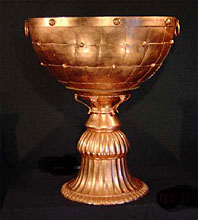
This pattern also structures the Creation week (Genesis 1), the Tabernacle speeches (Exodus 25-31) and the Ascension offering (Leviticus 1).
What is interesting is that the Firmament is Day 2 (Red Sea – death), but the Tabernacle puts it at Day 6 because Adam needs resurrection (Jordan).
So, in our services, at confession of sin, the saints are in the Laver. At Communion, the Laver is in the saints. We in Him and He in us.
Comments Off | tags: Feasts, Tabernacle, Worship | posted in Biblical Theology, Christian Life
Apr
11
2009
Chuck Lawless, Jr. writes:
I recently read a book by a mainline pastor who longs for the churches of his denomination to grow again. Comparing those churches to growing churches, he hinted throughout the book at what he could not bring himself to say forthrightly: growing churches are usually characterized by conservative theology…
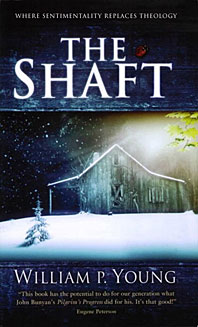 Thom Rainer’s works… have shown that churches that grow by reaching non-believers have a theology that is best described as conservative and orthodox. The bottom line is this: theology really does matter if we want to grow biblical, healthy churches.
We conservatives know this truth, and we are quick to remind others of this fact. What we are not so quick to acknowledge is the focus of this blog: we do a poor job of teaching the very theology that we claim is so important.
We think that our church members understand and believe our basic doctrine, even while those same members are learning their theology from TV talk show hosts, popular television preachers, or the latest religious novel.
Do an anonymous survey of your congregation’s beliefs, and see what you learn. If the majority knows and believes basic biblical doctrine, your church is more an exception than the norm.
Read more for practical tips on teaching theology.
Comments Off | tags: Church Growth, Preaching | posted in Biblical Theology, Christian Life
Apr
11
2009
Or, Reading the Bible without imposing your own worldview.
It seems we either read the Bible carefully but with the blinkers of remnant higher criticism (modernism), or we ‘get’ the narrative and typology but disregard the basic boundaries of responsible interpretation (postmodernism). Rich Lusk writes:
Biblical Theology requires us to learn to read the biblical narrative from within. We are insiders to the story of Scripture. It’s our story. We have to learn to read the Bible canonically. We have to allow the Word to absorb the world rather than allowing the world to absorb the Word. We have to take Scripture’s outlook as normative rather than imposing another worldview on our reading of Scripture. We must learn to read the Bible organically, in terms of itself. We should read the Bible the same way Peter, Susan, Lucy, and Edmond would read The Chronicles of Narnia: as a story not only for us, but about us.
Reading the Bible organically means reading it intertextually and typologically. Intertextual reading listens for echoes of and allusions to other passages within the canon, using Scripture to interpret Scripture. Typological reading looks for repeating patterns within the unfolding storyline of Scripture. Biblical typology is focused on totus Christus — the whole Christ, head and body, Jesus and the church. Typology means reading the Bible on its own terms, as a revelation of the suffering and glory of Christ (Lk. 24). As we move from type(s) to antitype, there is both correspondence and escalation.
Read his full article here.
Comments Off | tags: Biblical worldview, Hermeneutics, Higher Criticism, Modernism, Rich Lusk, Totus Christus, Typology | posted in Biblical Theology
Apr
11
2009
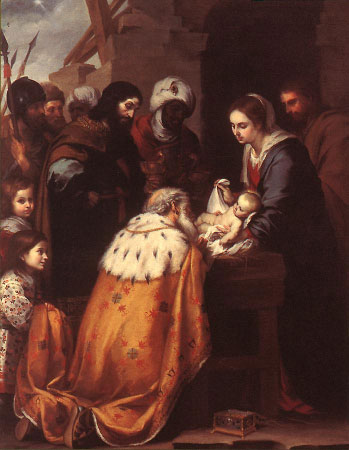 We don’t know how many wise men travelled from the east, but perhaps we can make a guess via God’s deliberate typology.
You must be logged in to see the rest of this post.
Join now for a year for $15!
1 comment | tags: Babylon, Christmas, Incense Altar, Lampstand, Table of Showbread, Typology | posted in Biblical Theology
Apr
11
2009
Interpretive Maximalism

Need help combating those pesky liberal scholars who insist the Bible has been cobbled together and is nothing but an archaic shambles? Or those premillennialists who gasp in horror when you mention that the church replaced Israel? You need a strong dose of interpretive maximalism. It cuts liberal scholarship and dispensational nonsense to shreds. How? It shows, using repeated typology, that orthodox preterism and postmillennialism flow naturally out of the Old Testament.
Continue reading
Comments Off | tags: Dispensationalism, James Jordan, Postmillennialism, Preterism, Replacement Theology | posted in Biblical Theology
Apr
10
2009
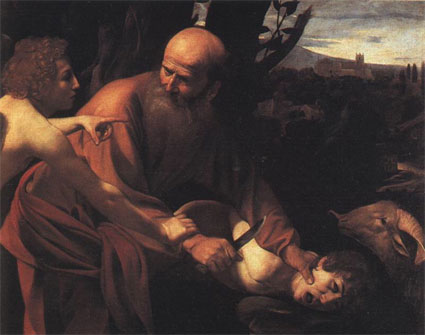
“For the word of God is living and powerful, and sharper than any two-edged sword, piercing even to the division of soul and spirit, and of joints and marrow, and is a discerner of the thoughts and intents of the heart.” Hebrews 4:12
NOTE: THIS POST HAS BEEN REMIXED AND INCLUDED IN GOD’S KITCHEN.
I thought for many years that the phrase “joints and marrow” in this verse was very strange. I guess this is a testimony to the artificial division of the Old Testament from the New by Bible teachers. It refers to the sword of the priest cutting up the sacrifice.
Continue reading
Comments Off | tags: Covenant curse, Holy war | posted in Biblical Theology, Christian Life
Apr
10
2009
“Prayer is not a retreat from the history of redemption into private ecstasies of communion. Prayer is a chief instrument by which the Father renews the world through His sons who are in the Son and who have received the Spirit.”
Peter Leithart, Romans 8, continued, www.leithart.com
Comments Off | tags: Peter Leithart, Postmillennialism, Prayer | posted in Biblical Theology, Christian Life
Apr
10
2009
In his lectures on worship, James Jordan comments:
The church is the first form of the kingdom. The church is also the nursery of the kingdom. It’s within the institutional church that the fundamental principles of the kingdom are taught and learned. Christians learn government through the church government of elders. Having learned that, Christians are then ready to govern in more broad circumstances. We learn finances in the church, through the administration of the tithe. We learn charity in the church because we are starving and God feeds us bread and wine.
We learn music in the church. All of western music flows out of the music of the church. All of western theatre flows out of the liturgy of the church. All of western literature flows out of the literature of the church.
The church creates civilisation. The church is the nursery of culture.1
Western culture, then, is at the stage of Solomon with his idolatrous wives. The church is now just mimicking the corrupted culture of the world instead of being the pioneer. And we know what happened to Solomon’s kingdom.
1 Ten Principles of Worship, Lecture 1. Available from www.wordmp3.com
Comments Off | tags: Compromise, Culture, Ecclesiology, James Jordan, Music, Solomon, Wisdom | posted in Biblical Theology
Apr
10
2009
If the Bible were only about salvation by grace, it would be a lot shorter. It is about a growth from childhood to maturity, from nakedness to glory.
Jesus grew in wisdom and stature. That goes back to the two trees in the garden, bread (obedient priesthood) and wine (kingly wisdom).
Jesus carried the people of God through Adam’s testing (breaking the bread), beyond the tree of life, to the tree of wisdom (poured out wine).
‘of Him you are in Christ Jesus, who became for us wisdom from God’ (1 Cor. 1:30)
‘in whom are hidden all the treasures of wisdom and knowledge.’ (Col 2:3)
He is both trees, and now we eat and drink Him freely before God.
Comments Off | tags: Communion, Genesis, Wisdom | posted in Biblical Theology