Jun
26
2013
 “Smooth narrative” is one of the arguments against the inclusion of the final verses of the Gospel of Mark. The Bible isn’t known for its smooth narrative, anyway, but the ending does seem to pick up the speed suddenly. Is there anything in the text that might point in the other direction? How about literary structure?
Mark follows a convention found throughout all the Bible’s texts, based upon the Creation Week and the Levitical Feasts (Leviticus 23). The gospel has a number of “Covenant-shaped” cycles, and the entire book is itself “Covenant-shaped.” This final cycle is left incomplete if the gospel ends at 16:8 (see below). The question is, does this “clockwork” internal textual evidence outweigh the shabby history of the manuscripts? Continue reading
Comments Off | tags: Literary Structure, Mark | posted in Bible Matrix, Biblical Theology, Totus Christus
Jun
25
2013
Comments Off | posted in Biblical Theology
Jun
24
2013
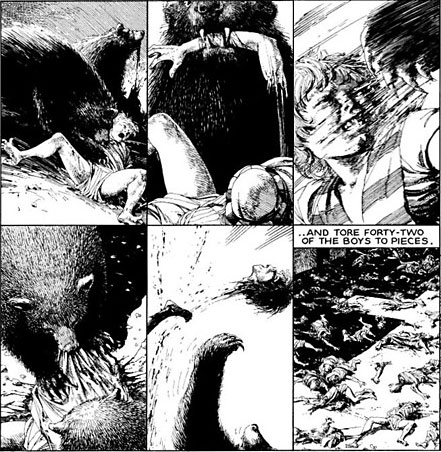
or Who Is The Real Jericho?
Atheists love to embarrass Christians with a snide reference to the story of Elisha setting two bears upon some helpless children. What nobody, even Christians, seem to get is the “Covenant significance” of all the players in the story, harking back to Moses. The prophets were, after all, God’s “repo men.” [1]
[This post has been refined and included in Sweet Counsel: Essays to Brighten the Eyes.]
Continue reading
Comments Off | tags: AD70, Covenant curse, Covenant Theology, Egypt, Elisha, Feasts, Herod, Jericho, Jezebel, Kings, Leviticus, Peter Leithart, Pharaoh, Revelation | posted in Apologetics, Bible Matrix, Biblical Theology, The Last Days
Jun
22
2013

“The reason literature, like art, has no hard-and-fast rules, is because authors and artists confer meaning upon things as they go.”
Recently on the hermeneutics exchange, Monica Cellio (one of the bright lights, whose eyes are like lasers) asked,
Do any principles commonly used in the field of hermeneutics have any counterparts in scientific principles? Is there a corollary in hermeneutics to the requirements that science demands as far as the reproducibility of experiments, peer review of results, etc?
This is a fantastic question, not because it will lead us towards a better understanding of the Bible, but because it exposes the reason why modern academics have such a problem with understanding and teaching the Bible.
Continue reading
3 comments | tags: Hermeneutics, James Jordan | posted in Biblical Theology, Quotes, Reading the Bible in 3D
Jun
20
2013
 The intro to the Reading the Bible in 3D seminar mentions the “jokes” in the Bible. In his book Deep Exegesis, Peter Leithart gives us a rundown on what a joke is to justify using the word to describe some of the allusions in Scripture. One of the reasons jokes are funny is their reliance on inside information.
Here’s my all-time favourite joke in the Bible.
Continue reading
Comments Off | tags: Covenant Theology, Daniel, Esther, Genesis, James Jordan, Joseph, Mordecai, Peter Leithart, Revelation, Typology | posted in Bible Matrix, Biblical Theology, Reading the Bible in 3D
Jun
13
2013

or “Nothing to see here, citizens. Go to your homes.”
Emeth Hesed blogged recently about “heads of households” meetings…
Since moving to the Land of the Free, I have enjoyed how well women are treated here. I can see that America really is a country with a Christian heritage even if it’s not a Christian nation anymore. But attending the church where my husband grew up, I have never felt so disenfranchised in my life. I have never felt so cut off from the covenant I was baptized into, from the rightful inheritance God has promised me.
Emeth makes some great points but the thing that strikes me about these “intramural” Presbyterian debates is the failure to identify the real villain.
Continue reading
4 comments | tags: Baptism, Covenant Theology, Ecclesiology, Federal Vision | posted in Biblical Theology
Jun
4
2013
or Bird’s Eye View
[This post has been refined and included in Sweet Counsel: Essays to Brighten the Eyes.]
Continue reading
2 comments | tags: Genesis, Herod, Noah, Revelation, Systematic typology, Urim and Thummim | posted in Bible Matrix, Biblical Theology, The Last Days
Jun
1
2013
How does Peter see the apocalyptic imagery of Joel in the events of Acts 2?
The first step is to take note of the context of Joel’s prophecy. It is the coming destruction of Jerusalem in 586 BC.
And it shall come to pass that everyone who calls on the name of the Lord shall be saved. For in Mount Zion and in Jerusalem there shall be those who escape, as the Lord has said, and among the survivors shall be those whom the Lord calls. (Joel 2:32)
Even if we identify the context, it may sound to us as if Joel is still looking forward to the first century events at the end of his predictions. The unfortunate chapter break between 2 and 3 stops us reading further, but if we keep reading without a break, the beginning of chapter 3 makes it clear that Joel is still speaking about the restoration from exile. God would judge all the Canaanite nations, including Israel, who had behaved like a Canaanite. But only Israel would resurface from the “flood” of Babylonian control, while all the Canaanite powers remained scattered forever. And Israel would be vindicated across the world, from India to Ethiopia, in the events of the book of Esther (predicted in Ezekiel 38-39).
This means that the particular “day of judgment” had already passed by the time Peter quoted the prophet, so he is not quoting the prophecy to announce its soon fulfillment. He is, however, announcing a similar destruction of Jerusalem and its Temple, with all that this entails.
Continue reading
Comments Off | tags: Acts, Joel, Pentecost, Peter | posted in Biblical Theology, Q&A, The Last Days
May
28
2013
or Back To Egypt in Ships

“That which they sought to save them from the condemnation of the Law of Moses has also innoculated them against the grace and Spirit of Jesus Christ.”
Pope Francis, in a recent homily, has written,
[This post has been refined and included in Sweet Counsel: Essays to Brighten the Eyes.]
Continue reading
3 comments | tags: Covenant Theology, Luke, Moses, Roman Catholicism, Ten Commandments | posted in Apologetics, Bible Matrix, Biblical Theology, Christian Life