Apr
16
2009
Some more thoughts on “bearing the marks” of Jesus as mentioned here.
Communion in the liturgy corresponds to Atonement. The saints carry the creation before the throne of God as mediators (Tabernacles). Then, after the doxology, we ride out into the world as “chariots” carrying the decree from the emperor (notice this pattern in Revelation 18-19).
So, if we follow the biblical pattern for liturgy, we are re-enacting every week what Christ accomplished in the AD30-70 “wilderness to Canaan” period. This is exactly where Israel failed in the book of Judges. It was a Levitical failure. God raised up judges to preserve His people from total destruction, but it began with the priesthood losing the plot as mediators, a failure of both judgment (manward and worship (Godward).
A pinch of bread and a thimble of cordial while breast-beating in silence is a Levitical failure. Communion is a celebration. The time for breast-beating is the confession at the beginning of the service. You wash before you come to the table.
: ( Confession - Christ crucified – Passover – Red Sea (we are “passed over”) Judgment
: ) Communion - boasting in Christ crucified – Atonement – Jordan (we “pass through”) Worship
At Communion, the “stigmata” of Christ are rewritten in us as living epistles, tablets of flesh, an invitation to Tabernacles. The pattern is renewed in the mediators, and we ride into the world with a renewed Covenant in a new week, as the Word to the world.
Well, that’s the plan. In the west, we seem to be at the mercy of the Philistines. This liturgical pattern often has children at this last step as the horses and chariots. It concerns the next generation. (Elisha’s bears appear at this step to deal with the “children” of Jezebel!) After Communion, we are the renewed children of the Table, offspring of the Marriage Supper of the Lamb.
Comments Off | tags: Chariots, Elisha, Jezebel, Levites, Liturgy, Stigmata | posted in Biblical Theology
Apr
16
2009
A thought from a student exam: In Mark’s gospel, as soon as the veil of the temple is torn, the centurion confesses Jesus as Son of God. It’s a crucial scene because it’s the first time any human recognizes Jesus as Son.
And the sequence of veil and confession is crucial. The temple existed to keep people away from the presence of Yahweh. Jews were called to be nearer, and Gentiles further. If the temple is open, it doesn’t fulfill this function anymore. There’s a way into the holy place, and at the very moment a way is made into the holy place the division of Jew and Gentile becomes irrelevant.
Peter Leithart, www.leithart.com
Brilliant observation. It reminded me that the firmament of Day 2 (and the 2nd Tabernacle speech, which concerns the veil) correspond to the Confession in the liturgical pattern set by the Creation week.
Comments Off | tags: Creation Week, Holy Place, Peter Leithart, Tabernacle, Veil | posted in Biblical Theology
Apr
16
2009
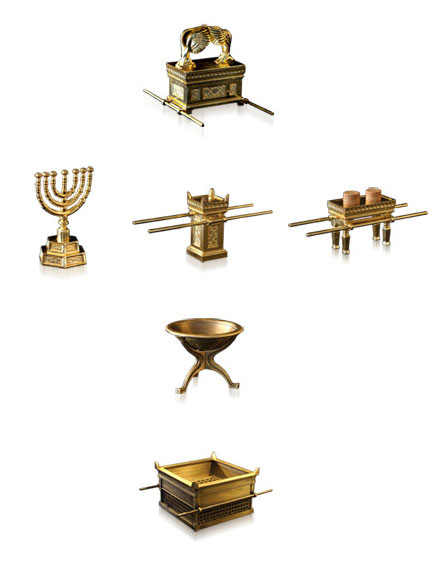
The Tabernacle was not only a “portable Sinai”, the mountain of God laid out across the ground, it was the cruciform Man. We see Jesus, with the Throne of God on His shoulders (the Ark – government), bread and wine in His left hand (the Table - servanthood), the ‘seven stars’ of the Lampstand in His right (dominion), and His feet on the crystal sea (the Laver – resurrection). And He is lifted up “in the air” between heaven and earth (the Altar-Land) as the Mediator Who unites God and man.
As the Ark (Moses), with arms outstretched (Bread – Aaron, and Ruling Lights – Hur), He is the prophet, priest and king Who defeated Greater Amalek at Sinai.
Comments Off | tags: Amalek, Ark of the Covenant, Lamps, Laver, Moses, Revelation, Sinai, Tabernacle, Table of Showbread | posted in Biblical Theology
Apr
16
2009
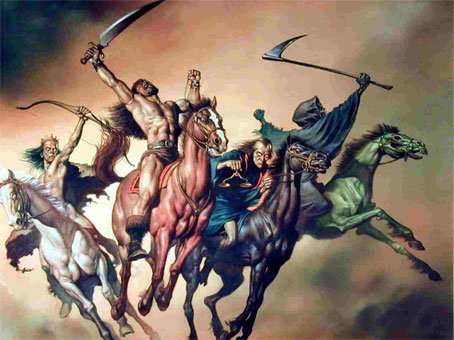
When he opened the fourth seal, I heard the voice of the fourth living creature say, “Come!” And I looked, and behold, a green [Greek: chloros] horse! And its rider’s name was Death, and Hades followed him. And they were given authority over a fourth of the [Land], to kill with sword and with famine and with pestilence and by wild beasts of the [Land].
The four horsemen of the apocalypse are the Gospel. They are released as the seals on the New Covenant scroll are broken by Christ after His ascension. The white horse brings the Word, the red horse brings division (as Jesus promised), the black horse starves the old order (or Covenant) but does no harm to the new, and finally, the green horse (a Levite with a sword1), ends the old order.
Continue reading
Comments Off | tags: Ascension, Creation Week, Dominion Theology, Four Horsemen, James Jordan, Revelation | posted in Biblical Theology, The Last Days
Apr
16
2009
“There were hangings of fine white and violet linen held by cords of fine purple linen on silver rings and marble columns, and couches of gold and silver on a mosaic pavement of porphyry, marble, mother-of-pearl and precious stones.” Esther 1:6 [NASB]
In his Esther lectures, James Jordan observes that Ahasuerus is pictured as being enthroned over his very own crystal sea.
Nero was the first ruler in history to be buried in porphyry. For this ‘bad Ahasuerus’ who exercised false judgment, the crystal sea became a laver of fire. We know from Revelation 14:10 that the lake was before the heavenly throne.
“Then the beast was captured, and with him the false prophet who worked signs in his presence, by which he deceived those who received the mark of the beast and those who worshipped his image. These two were cast alive into the lake of fire burning with brimstone.” Revelation 19:20
Herod’s Temple was covered in marble. Revelation shows it replaced with a crystal city. The church is now the Laver. Baptism symbolises the gospel as walls to the wicked and gates to the righteous: fire and ice. Jesus’ kingdom is the fifth empire and His judgment is righteous and uncompromising.
“So then, because you are lukewarm, and neither cold nor hot, I will vomit you out of My mouth” Revelation 3:16
It might look like I’m colouring outside the lines, but it’s in line with a very consistent Biblical symbolism.
Comments Off | tags: Baptism, Crystal Sea, Esther, James Jordan, Nero, Revelation | posted in Biblical Theology, The Last Days
Apr
16
2009
…let us consider one another in order to stir up love and good works, not forsaking the assembling of ourselves together, as is the manner of some, but exhorting one another, and so much the more as you see the Day approaching… you have need of endurance, so that after you have done the will of God, you may receive the promise: “For yet a little while, and He who is coming will come and will not tarry.”
(Hebrews 10:24-25 and 36-37)
The resurrection that the New Testament writers were looking forward to occurred in the first century. They refer to it as being imminent. Jesus said some who heard His words would see His coming before they died. John would remain alive until Jesus came in judgment. It was the saints receiving the kingdom and being resurrected. Now the church governs the world from heaven, and its heavenly ‘Temple’ pattern is being measured out on the earth.
Continue reading
1 comment | tags: AD70, Against Hyperpreterism, Cain, Genesis, Millennium | posted in Against Hyperpreterism, Biblical Theology
Apr
16
2009
This event would explain the massive discontinuity between the apostles and the church fathers. James Jordan writes:
The true Fathers of the Church are Noah, Abraham, Joseph, Moses, Jeremiah, Jesus, Paul, Peter, and John, and the other Fathers in the Bible. These men, under the guidance of the Holy Spirit, created the apostolic deposit from which the Church always grows. The men who came after them, in the first and second and third centuries, are not Church Fathers but Church Babies. We may think that because these men lived right after the apostles, they must have known a lot. Remarkably, this is not the case. Anyone who reads the Bible, climaxing in the New Testament, and then turns to the “apostolic fathers” of the second century, is amazed at how little these men seem to have known…
Continue reading
Comments Off | tags: AD70, Church Fathers, Church History, Firstfruits, James Jordan, Resurrection | posted in Against Hyperpreterism, Biblical Theology, The Last Days
Apr
16
2009
The Mission
or World Without End?
With all the fuss between hyperpreterism and preterism, is it possible both positions are basically right?
Hyperpreterists realise that the apostles were expecting an immiment resurrection, and the partials have to treat verses inconsistently – applying some to AD70 and some to the end of history. But then the hypers have to squish the millennium into AD70 like a fairground mirror. They believe all prophecy has been fulfilled. Not good.
Continue reading
Comments Off | tags: AD70, Against Hyperpreterism, Hermeneutics, Judgment, Moses | posted in Against Hyperpreterism, Biblical Theology, The Last Days
Apr
16
2009
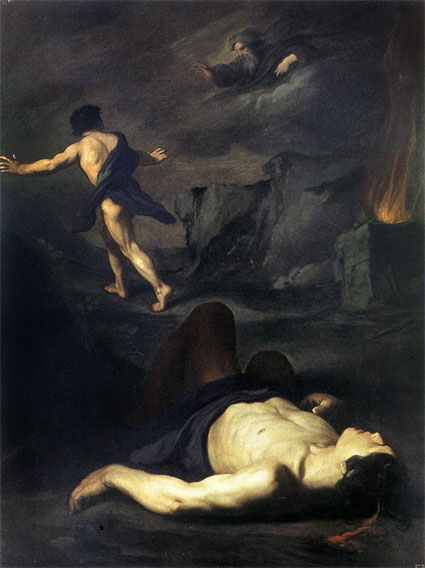
The Rest of the Dead
I saw the souls of those who had been beheaded for their witness to Jesus and for the word of God, who had not worshiped the beast or his image, and had not received [his] mark on their foreheads or on their hands. And they lived and reigned with Christ for a thousand years. But the rest of the dead did not live again until the thousand years were finished. This is the first resurrection. Revelation 20:4-5
James Jordan writes:
Continue reading
Comments Off | tags: Abel, AD70, Cain, James Jordan, Millennium, Resurrection, Revelation, Temple | posted in Against Hyperpreterism, Biblical Theology, The Last Days, Totus Christus
Apr
16
2009
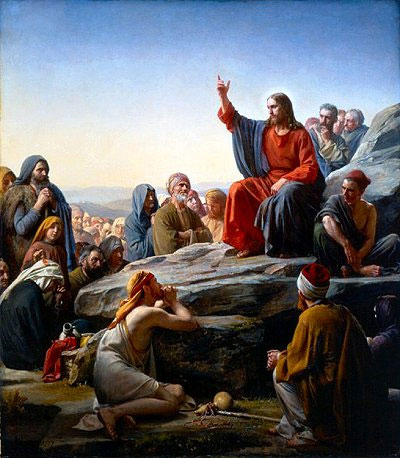
[Jesus] was a master of ready speech and witty repartee, but most of the sayings that have come down to us bear every sign of careful preparation. They have the qualities of poetry, and with the aid of paradox, exaggerations, or play on words, were cast in such a shape as would enable them to find their way into the dullest mind and stay there.
Continue reading
Comments Off | tags: Sermon on the Mount | posted in Biblical Theology, Quotes