Apr
24
2010
Genesis Redux – Part 1
Well, here it is, live at last. Enjoy.


From John Barach’s blog:
In the introduction to the sixth volume of G. K. Chesterton’s Collected Works, while working toward some explanation of The Man Who Was Thursday, Denis Conlon quotes Chesterton’s Introduction to the Book of Job (1907):
Ralph Smith helpfully applies the five point Covenant model to the history of Israel between the captivity and Christ:
1) Transcendence: God’s sovereign control over the nations was revealed in this period of the old covenant more than any other. Daniel foresaw the whole history of the world from the time of Babylon to the time of establishment of the kingdom of the Messiah (Dan. 2:27ff.; 7:1ff.). Clearly the kingdoms of this world were in His hand and He was guiding history where He willed. For the Jews as a nation, this greater revelation of God’s Kingship was important for they would be apparently in the hands of unbelieving rulers through much of this period, but the fact that God had predicted the history of the entire era from the beginning put all of this in a different light. The Jews learned anew that “The king’s heart is in the hand of the LORD, as the rivers of water: He turneth it whithersoever He will” (Prv. 21:1).
“Do not forgive them, Father. They know exactly what they are doing.”
THIS POST HAS BEEN REMIXED AND INCLUDED IN GOD’S KITCHEN: THEOLOGY YOU CAN EAT AND DRINK
You must be logged in to see the rest of this post.
Join now for a year for $15!
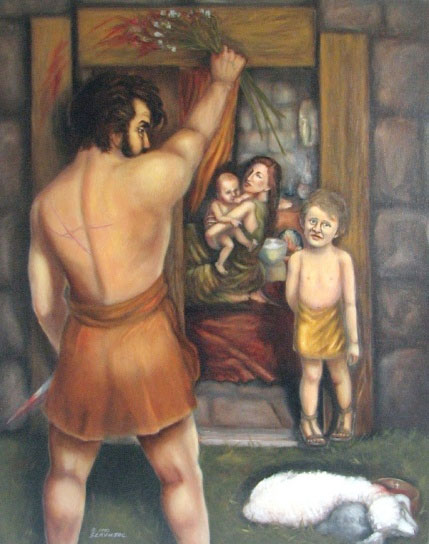
Throughout the Bible there are two doors, or more correctly, a door and a window.
Both of them involve blood. The first takes us out of the world. The second puts us in government. The first is the Passover door, the second is a window in Jericho. One mirrors the other chiastically in the journey from slavery to Sabbath.

Keith Mathison writes:
“…apocalyptic literature was oriented toward the future and expressed its message in vivid symbolism encoded in dreams and visions. It is a genre of revelatory literature with a narrative framework, in which a revelation is mediated by an otherworldly being to a human recipient, disclosing transcendent reality.” [1]
Although this statement from Mathison’s helpful book is true, the more I learn the more I tend to believe our genre classification leaves a lot to be desired. The Bible is more organic than that.

Timothy Edwards has some really interesting things to say about interpreting Psalm 1 over at Credenda/Agenda. Of course, I thought the matrix might help things as well. Here’s my go at it.

Human talent amazes me. Totally aside from the child prodigies, we are an extremely gifted bunch. After only a couple of decades on the planet, from those who have the opportunity to apply themselves with enthusiasm to their particular area of interest, we see some incredible achievements. For the godless, this should certainly seem miraculous. But for our dark hearts it just proves how smart and wonderful we already are in ourselves. This is the ingratitude Paul speaks of.
For Christians, talent (or beauty or wealth) is just another dead giveaway of God’s existence. And God Himself almost seems to despise this early glory as a short-lived covering of wildflowers that appears suddenly after some long-awaited rain. This is the glory of youth and it is insufferably vain. It exalts itself by calling its competition dumb and ugly.
Part 1 here.
One thing the Bible Matrix demonstrates is the nature of history. Sure, it repeats itself. Everyone knows that. But our personal histories are microcosms of the lives and deaths of families, churches, nations and empires. Reading the Bible is like looking through a glass onion.



 Bible Matrix blog