Jul
7
2009
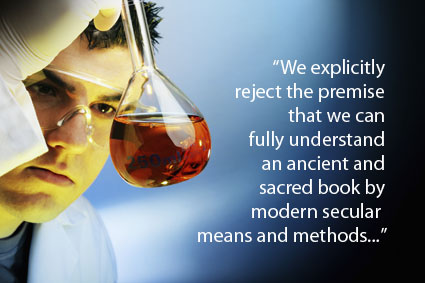
A quote from Theological Poetics: Typology, Symbol and the Christ, by Warren Gage of Knox Seminary:
A modern introduction to biblical typology should begin inductively with several examples of certain shadows and types from Old Testament passages widely acknowledged to be prefigurative in character, seeking to understand those types as interpreted by the authors of the New Testament. After a number of such passages are examined, an index of the “criteria of certainty” should be proposed to distinguish legitimate “types” from suspected “allegories.” Principles of interpretation should then be announced, along with the obligatory caveats necessarily qualifying tentative proposals, all of which should be rationally defensible and clearly recognizable to reputable scholarship in the field.
Our approach will be quite different. Continue reading
2 comments | tags: Modernism, Typology, Warren Gage | posted in Biblical Theology, Quotes
Jul
6
2009
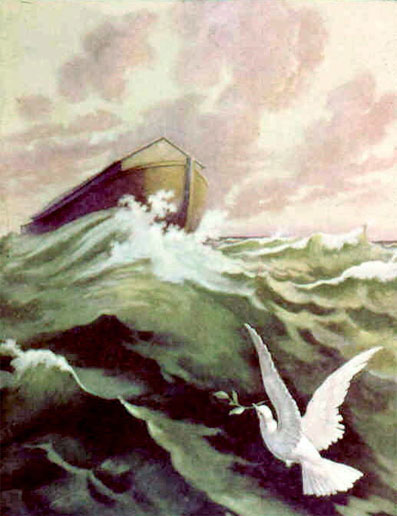
If we don’t get Genesis right, we’ll get much of the Bible wrong. In Through New Eyes (PDF), James Jordan identifies a three-level “cosmos” in the Creation, which is reflected on the earth. There is the Garden Sanctuary, the Land of Eden, and the Outlying Lands, or Garden, Land and World.
This is reflected, not only in the ark of Noah, but also in the Tabernacle. The image is dual, one in heaven and one on earth:
Continue reading
Comments Off | tags: Against Hyperpreterism, Altar, Babel, oikoumene, Paul, Tabernacle | posted in Against Hyperpreterism, Biblical Theology, The Last Days
Jul
5
2009
You can listen to a 2009 series of lectures on worship by James Jordan here.
They will make you cry for the lack of Bible content (and understanding) in teaching today, and laugh at what gets passed off as instruction for better worship.
If many of the things he says sound bizarre, it’s because he’s being biblical. It’s Bible-strange, but it’s we who are estranged. He’ll give you enough to chew on for decades, and you’ll realise how deficient, gnostic, watered-down and compromised even the best of modern theology is.
But these are a sumptuous feast for worship leaders, in fact, anyone in church leadership. Go on, I dare you.
6 comments | tags: James Jordan, Worship | posted in Biblical Theology
Jul
3
2009
“Be meticulous to present yourself for the praise of God as an unashamed workman, cutting the word of truth in a straight line.” (II Timothy 2:15)
Is this verse simply teaching that if we “divide up” the Scriptures correctly, we’ll get an AWANA[1] merit badge from God? Hardly. It is flanked by condemnations of those who fight over the Scriptures to no profit, and those whose vain babblings are gangrenous.
Paul speaks of a soldier and a farmer, and then a productive workman. Paul is concerned about building saints and churches, and they are built by a straight and true cutting of the word. Like most of Paul’s statements, there is a very long, fully-loaded freight train of Old Testament history and typology right behind it, and it’s coming right at you, right now.
Continue reading
Comments Off | tags: Darius, David, Esther, Ezekiel's Temple, Nebuchadnezzar, New Jerusalem, oikoumene, Peter, Peter Leithart, Postmillennialism, Revelation, Solomon, Stigmata, Temple, Totus Christus, Worship | posted in Biblical Theology, Christian Life, The Last Days, The Restoration Era
Jul
2
2009
or Suffering as the Most Holy Place

I remember an atheist quoting one of David’s Psalms to prove that God doesn’t answer prayer. It was a song of despair. Despite such selective quoting, how do we deal with Bible passages that end without hope?
Continue reading
1 comment | tags: David, Despair, Jeremiah, Jonah, Lamentations, Michael O'Brien, Psalms | posted in Biblical Theology, The Restoration Era
Jul
1
2009
Or, Adam as bread; Christ as bread and wine.
“Now when He had spoken these things, while they watched, He was taken up, and a cloud received Him out of their sight.” –Acts 1:9
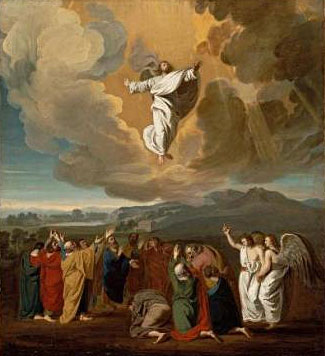 “Jesus went through everything He went through, His incarnation, His life, His death, His resurrection, in order to ascend as man to heaven in the cloud… The glory cloud is God’s mobile home, a chariot-throne in which He drives around and manifests His presence, glory, grace and judgment.
This cloud shows up a lot more often in Scripture than you would think. We all know that the cloud brought the people through the wilderness, but the cloud is all over the place in the Bible. Sometimes you only get a hint that it’s there by the sound that it makes, its voice, a sound like a rushing mighty wind.
The cloud was at the Creation, at the Red Sea crossing, at Mount Sinai, in the wilderness, in the Tabernacle and in the Temple. It is God’s throne room, His sanctuary. This is where Jesus Christ ascended. The ascension marks the climax of what the Word was made flesh for. God created man for the purpose of ascension and transfiguration.
When Paul talks about the natural body versus the spiritual body, he doesn’t mean physical versus non-physical. He is contrasting the physical body with which Adam was created with the ‘supra-physical’ body which Christ now has…
Christ divested Himself of the glory of His divinity, in order to receive the glory that He had before, but now to receive it as Man, and to share it with us.”
“The first man Adam became a living being. The last Adam became a life giving spirit” –1 Corinthians 15:45
– David Chilton, Ascension and Kingdom, Basilean Lectures 1990. Available from www.wordmp3.com
Comments Off | tags: Adam, Ascension, Communion, David Chilton, Glory cloud | posted in Biblical Theology, Quotes
Jul
1
2009
“Because of 18th century rationalism in our culture, we are the heirs of a tradition of thinking that downplays symbolism in communication. The assumption is that all truth comes in the categories of philosophical statements. We are very much at home reading St Paul because he uses abstract language: justification; sanctification; glorification; propitiation… We think that this is the best way to communicate and nail things down.
But this is not the way God communicates. God communicates in parables as well as abstract ideas. God communicates in architectural forms, in proverbs, in songs. God’s way of educating young people is the Proverbs. Our way is to make them memorise a list of abstract nouns. That’s what the Shorter Catechism is. The Proverbs have a different way of communicating, a way that is much more holistic. It strikes the human personality at a deeper level.”
–James B. Jordan, The Bible as Picture, Basilean Lectures 1990.
Comments Off | tags: James Jordan, Paul, Proverbs, Rationalism | posted in Biblical Theology, Quotes
Jul
1
2009
“Nothing is plainer than that Paul sets his gospel over against all the doings of the carnal man, and not against the expectant but faithful Jew.”
Excerpt from Called To Be An Apostle
Sermon by Doug Wilson, Nov 25, 2008.
 “In our overview of the entire book of Romans, we noted that chapter one showed the Gentiles were under sin, chapter two showed the Jews under sin, and chapter three showed them both up to their necks in the same kind of sin. This is important for us to note at the beginning of this book because the gospel set forth here is a gospel that liberates the nations from wickness, evil, sin, mortality, and so forth. This will be important for us to understand when we get to chapter seven, and Paul’s description of himself there as a representative Jew, but it is also important for us to see the nature of Saul’s conversion to Christ rightly. Otherwise, we will get everything confused. For now, we need to see that the gospel directly addresses what preachers in another era used to call sin.
Continue reading
Comments Off | tags: Circumcision, Doug Wilson, New Perspective on Paul, Paul | posted in Biblical Theology, Quotes
Jun
30
2009
 “And their dead bodies will lie in the street of the great city which spiritually is called Sodom and Egypt, where also our Lord was crucified.” – Revelation 11:8
Revelation 20 makes it clear that the “second death” is the lake of fire. But an analysis of the literary structure of Revelation brings out an interesting factor.
Continue reading
Comments Off | tags: Against Hyperpreterism, Armageddon, Atonement, Azal, Egypt, Feasts, James Jordan, Passover, Peter Leithart, Revelation 20, Smyrna, Sodom, Systematic typology, Tabernacle | posted in Biblical Theology, The Last Days, Totus Christus
Jun
29
2009
James Jordan’s work on the Jew-Gentile oikoumene set up in Daniel has far reaching implications.1 Peter Leithart writes:
“Yoder argues that from the time of the Babylonian captivity, the Jews developed a proto-”free church” model of community life. True in some respects. Jews didn’t have their own polity. But I’ve got doubts if that’s a fair characterization of Jews in and after the exile.
Continue reading
Comments Off | tags: AD70, Archaeology, Daniel, Esther, Exile, Hellenism, Mordecai, Nehemiah, oikoumene, Peter Leithart, Tertullian, Yoder | posted in Biblical Theology, Quotes, The Last Days, The Restoration Era