Apr
10
2009
The Ark was always to be carried by human legs, never on a beast or a man-made cart. The Jewish rulers and religious leaders were content to keep God in a box, symbolically hidden behind a veil. But in Christ, the Ark was free and walking around on human legs with the eyes and mouth of a Man. When the Ark was mobile, the people of God followed, seeking rest and scattering His enemies on the way (Numbers 10:33-34).
The Ark was a covering that protected Israel from the consequences of face-to-face exposure to God’s Law. With the Ark taken by God, the Restoration Covenant would be different. The synagogues would come into their own, and the Law would be studied by all Jews throughout the empire:
But this is the covenant that I will make with the house of Israel after those days, declares the Lord: I will put my law within them, and I will write it on their hearts. And I will be their God, and they shall be my people. And no longer shall each one teach his neighbour and each his brother, saying, ‘Know the Lord,’ for they shall all know me, from the least of them to the greatest, declares the Lord. For I will forgive their iniquity, and I will remember their sin no more.” (Jeremiah 31)
The next fulfilment was the bodily incarnation of the Words, Jesus Christ. He was both the Law of God written on tablets of flesh, and the blood covered container that protected Israel from extermination. They all knew Him, from the least to the greatest. Like the Ark, His words were a flaming sword that would bring either life or death to His hearers.
And of course, we are familiar with Paul’s explanation of this being applied to believers who are His body. Our words also bring division:
“…clearly you are an epistle of Christ, ministered by us, written not with ink but by the Spirit of the living God, not on tablets of stone but on tablets of flesh, that is, of the heart… for the letter kills, but the Spirit gives life.” (2 Cor. 3)
Comments Off | tags: Ark of the Covenant, Typology | posted in Biblical Theology, The Restoration Era
Apr
10
2009
“Are we Western Christians truly suffering because of Christ? Or the lack of us standing up for Christ?”
Good point. Once again I would use the book of Esther. The role of restored Israel was to be witnesses within the world empire, as Daniel had been. It seems Mordecai sought to be like Joseph or Daniel, but by compromising Esther’s witness, Haman ‘usurped’ his role at the right hand of the throne (a pattern begun in the Garden of Eden).
However, God used the situation for good, and Esther provides us with an historical blueprint for events in the first century:
Continue reading
Comments Off | tags: Amalek, Esther, Haman, Mission, Mordecai, Witness | posted in Biblical Theology, The Restoration Era
Apr
10
2009
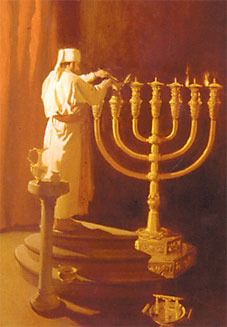 The golden Lampstand, with seven flames, pictured the sun, moon and five planets (those visible to the naked eye) that govern the firmament*—the seven “eagle-eyes” of God. In Ezekiel 1, this corresponded to the face of the Eagle that always faced north, watching over the people of God, the Table of Showbread (the face of the Man).
The Lampstand was also a stylised almond tree. In Hebrew, the word translated “almond” is also the word for “watcher, overseer.” An almond tree is a shepherdwho grows out of the earth and reaches heaven—a Tree of Life.
The serpent usurped Adam’s authority in the garden, and he became the legal judge (satan) of mankind, standing full of eyes before the ark/throne – seven stars at God’s right hand. As the ancients, including Solomon, sculpted wild beasts to guard their thrones, so this angelic tutor became a beast “crouching at the door.” Man had to pass him to reign with God. We see him before God’s throne in Job. He roamed to and fro on the Land like a raven and returned to accuse God’s people. The angel of light—the shepherd “Lampstand”—had become a wolf.
*The governing lights were created on Day 4. The speech concerning the Lampstand is the fourth speech regarding the Tabernacle construction.
Comments Off | tags: Creation Week, Lampstand, Satan, Typology | posted in Biblical Theology
Apr
10
2009
Rieu’s theory of Jesus as a ‘man of letters’ is borne out by the structure of the Sermon on the Mount. As with many of the prophets, His “book” begins with a preamble that follows the themes of Israel’s 7 feasts in Leviticus 23.
Jesus begins with the Sabbath rest of those who have a humble spirit, works through those who mourn for their sins at Passover, and ends with the Atonement covering of the blood of those who would be persecuted yet to be shed on the Land. And at Tabernacles, their reward is in heaven.
Continue reading
Comments Off | tags: Feasts, Literary Structure, Pharisees, Sermon on the Mount | posted in Biblical Theology
Apr
10
2009
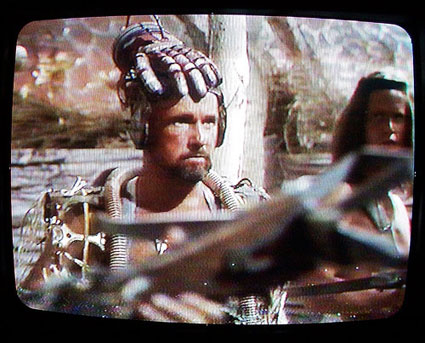
There is an old Doctor Who episode where the crew of a crashed spaceship, after many generations, degenerated into two warring tribes, the Tesh (from the technicians) and the Sevateem (from the trained pioneers, the survey team).* The remaining wreckage became religious artifacts used for various superstitious rites which were originally very practical operations for planetary conquest.
The reason most of the Bible seems culturally irrelevant to modern evangelicalism is because it is a tool for change. Our culture has moved so far from biblical thinking, so distorted from the heavenly pattern, that we don’t recognise the original ‘cast’ when we see it. We want to change our culture, and we have the tools. We carry them around with us in leather cases. They sit in racks in the pews. But we have lost the plot. The Tesh hide in gnostic academies. The Sevateem degenerate into superstition. The alien jungle terrorises them both. They war with each other and the planet goes unconquered.
*The villain turned out to be the damaged computer which was behaving like a capricious Greek god. We have no excuse. It is not our God that is malfunctioning, but us.
Comments Off | tags: Add new tag, Biblical worldview, Gnosticism | posted in Biblical Theology
Apr
10
2009
“While he languished in prison, Joseph had no idea what was going on in Pharaoh’s heart. He did not realise that God the Holy Spirit was at work making Pharaoh dissatisfied. He did not know that one night God would bring His Word to Pharaoh and Pharaoh would need someone to interpret it. He did not know that one day his suffering would be rewarded, and he would stand before the king of the earth.
This should encourage us. We pray for our rulers and those in authority over us, but we don’t see them change. We have no way of knowing, however, what God may be doing. Our God is still the “God of Nightmares”! In our secular humanist society, Christians are often “in prison” in various ways. Yet God’s Word is faithful, and the time will come when secular society will turn to God’s people for help.
May we be ready for the day we stand before kings.”
- James B. Jordan, Primeval Saints, p. 140.
Comments Off | tags: Bible history, James Jordan, Joseph, Pharaoh | posted in Biblical Theology, Quotes
Apr
10
2009
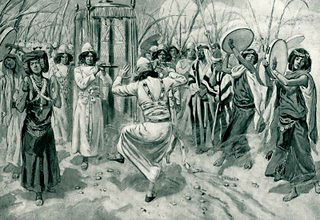 What gave David the right to add music, singing and dancing to the Tabernacle worship? The Tent of Moses was a place of silence.
The answer is in Deuteronomy. The Law was given to Moses at Sinai (Firstfruits), and repeated to the next generation before Israel crossed the Jordan. In between was 40 years of testing in the wilderness. God spoke at Sinai, and Moses listened in silence. But in Deuteronomy (Trumpets), it was Moses, the mediator, who “sang” the Law (Deut 31-32).
On to King David. After the continued flagrant disobedience of the sons of Eli, the Ark took itself into the ‘wilderness’ on Israel’s behalf at the hand of the Philistines, and conquered the serpent (Dagon). Besides a plunder of Philistine gold, it returned with both Jew and Gentile singers in a restructured worship that included music. The silent Tent of Moses, ready to pass away, had been broken down and prepared for incorporation into a permanent Temple built of David’s spoils. It was a bride ready for Solomon the bridegroom.
In the New Testament, following Christ’s example, the church came out of the Egypt of corrupted Judaism. She was tested in the wilderness, like Israel, with persecution and false teachers. Before the full inauguration of the New Covenant in AD70, she was presented as a bride ready for her husband, a rebuilt Tabernacle of David (Isaiah 16:5; Amos 9:11; Acts 15:16). Paul the tentmaker had completed the difficult process of stitching together a bride from both Jewish and Gentile worshippers. Purified by testing, she was a wise virgin with her lamps full of Pentecost oil. Her music was a new song accompanied by the seven Trumpets that brought the fall of Herod’s Jericho. The marriage feast of the Lamb followed, and Greater Solomon now rules the earth with His bride – a Temple built of living stones – until all enemies are under His feet.
At ascension (Firstfruits), Adam speaks and Eve listens as a people. Testing follows. At Trumpets, Greater Eve is a holy army ready to conquer. Now Eve sings.
Comments Off | tags: David, Feasts, Moses, Tabernacle, Temple | posted in Biblical Theology
Apr
10
2009
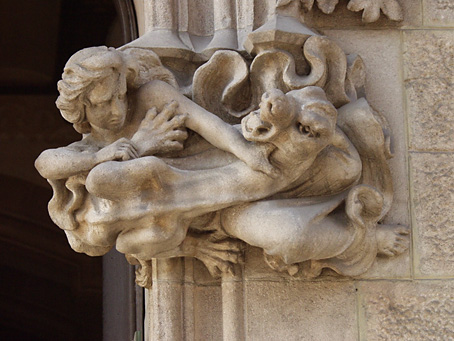
“…the coming of the kingdom means that the saints are, in Christ, seated in heavenly places, enthroned in fulfillment of the dominion mandate. Heavenly dominion over sin and Satan is the basic form of dominion for the individual Christian. But the Bible teaches that the saints have dominion over earth as well as heaven (Rev. 5:10). Heavenly dominion is over “spiritual forces of wickedness in the heavenly places” (Eph. 6:12), but by exercising this heavenly dominion, the church rules also on earth. The rule of the church over the demons is not only subjective and spiritual, but has objective historical consequences.
Continue reading
Comments Off | tags: Compromise, Holy war, Peter Leithart, Postmillennialism | posted in Biblical Theology, Ethics
Apr
10
2009
The Old Testament surely has a measure of built-in obsolescence. But it is the obsolescence of childhood. The New Testament, the Covenant of the Man, cannot be truly understood without a detailed knowledge of the Old. A friend posted this quote from Rudolph Bultmann: “who went on to cast a large shadow of influence over 20th century theology. Bultmann argues that the whole Old Testament narrative is of no importance to the Christian faith.”
Continue reading
1 comment | tags: Biblical worldview, Bultmann, Church History, Gnosticism, Hermeneutics, Peter Leithart, Philosophy, Typology | posted in Biblical Theology
Apr
10
2009
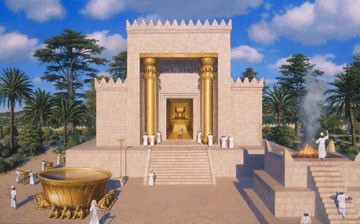
When Solomon’s Temple replaced the Tabernacle, everything was more glorious. Among the enhancements and additions were two great bronze pillars at the entrance. One of the things the Tabernacle symbolises is a great metal man. The glorified Christ is seen in visions with legs of molten bronze, or a fiery, angelic stream that reaches down to the Altar of the earth. The Tabernacle was a portable ‘flying’ chariot of God. These two great pillars, priest and king, were its landing gear.They pictured the union of heaven and earth, and Jew-priest-Land and Gentile-king-Sea in Christ, Greater Solomon.
“I saw still another mighty angel coming down from heaven, clothed with a cloud. And a rainbow was on his head, his face was like the sun, and his feet like pillars of fire. He had a little book open in his hand. And he set his right foot on the sea and his left foot on the land…” (Revelation 10:1-2)
Comments Off | tags: Revelation, Tabernacle, Temple, Typology | posted in Biblical Theology