Sep
2
2010
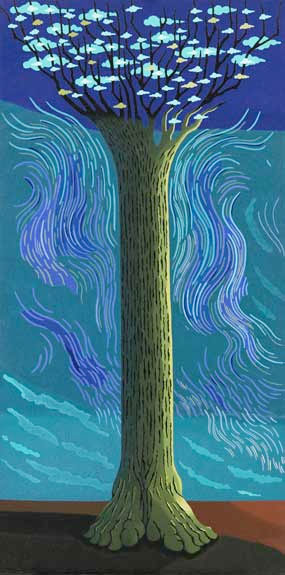
From James B. Jordan’s fascinating Thoughts on Jachin and Boaz [1]
“The Tabernacle and Temple were not only pictures of the kingdom of God. They were also pictures of the human person (John 2:21). We have noted that the High Priest had a chain around his neck, and pomegranates and bells encircling the ephod. Without any difficulty we can see the 1-cubit collar of the pillar as a neckband, the lily as the head, and the bronze shaft as the trunk. The size and proportions are roughly equivalent to those of a 5’ man.
Continue reading
Comments Off | tags: goliath, James Jordan, Temple | posted in Biblical Theology
Sep
1
2010
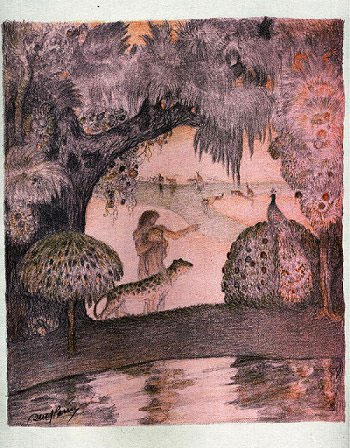
From James B. Jordan’s Trees and Thorns: [1]
The water in the ground of the garden is associated with Eve.
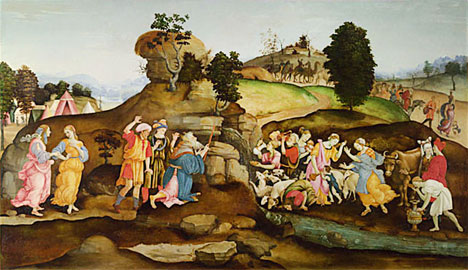
What Adam was to guard was the Garden, and preeminently Eve, its mistress. This is precisely what he refused to do. Later in the Bible, new Adams meet their Eves at wells, and defend them there. Eliezar met Rebekah at a well, and brought her home to Isaac (Gen. 24:11ff.). Jacob met Rachel at a well, and unsealed it for her — a sign as it turned out of his coming marriage to her (Gen. 29:10-11). Good Shepherd Moses met Zipporah at a well and defended her against bad shepherds (Ex. 2:16-19).
Continue reading
Comments Off | tags: Greater Eve, James Jordan, Marriage | posted in Biblical Theology, Creation, Quotes
Aug
31
2010
From James B. Jordan’s Trees and Thorns: [1]
The land and garden of Eden were watered by a spring. Why call attention to the fact that God did not send rain? Why not just mention the spring and leave off the statement about rain? The reason, I believe, is to call our minds back to Genesis 1:2-9. We find in Genesis 1:2 that there was an ocean over the original earth. Then God created the firmament, and separated the waters above from the waters below. On the third day God gathered the waters below into areas below the surface of the land.
Now we have a clear distinction between waters above the firmament, the source of rain, and waters below, which would have to come up from under the earth. Both Genesis 1:2-9 and 2:5-6 set up the distinction eschatologically; ground water comes first, and then heavenly water.
Continue reading
Comments Off | tags: Egypt, Genesis, James Jordan, Moses, Sodom | posted in Biblical Theology, Creation, Quotes
Aug
28
2010
or Preterism is not a Dirty Word
 .
.
One thing that has struck me since becoming a preterist is how much evangelicals play down the badness of the baddies in the New Testament, i.e. the unbelieving Jews and Christian Judaisers.
Evangelicals would never believe that Jesus and the apostles were mistaken in their warnings of an imminent judgment (and let’s face it, this imminence is a facet of the New Testament that is inescapable). So the only other option they see as viable is a position that defies logic: an event that was near, at the doors, yet could happen at any time over next few millennia.
Continue reading
4 comments | tags: antichrist, Evangelicalism, Hermeneutics, John, Peter Leithart, Preterism | posted in Biblical Theology, The Last Days
Aug
26
2010
or Behold, I Make All Things Bloody

A critic wrote that Mel Gibson, with The Passion of the Christ, invented a new cinematic genre: the religious splatter film. This was intentionally disrespectful, but of course there is some truth to it. Perhaps more truth than we realise. God desired a world covered by blood.
The content of this post has been revised and included in Bible Matrix II: The Covenant Key.
________________________________________
[1] A summary of James B. Jordan, Re-Creation in the Ascension Offering. Notice that the Tabernacle furniture itself, of course, also aligns with this structure of events, being a microcosmos.
[2] See Half the Blood.
[3] See also The Whole Bloody Bible.
2 comments | tags: AD70, Ascension, Herod, James Jordan, Leviticus, Nero | posted in Biblical Theology, Quotes
Aug
24
2010
or Mutton Dressed Up as the Lamb
Doug Wilson recently made a distinction between what usually passes for hypocrisy in Christian circles, and the kind practiced openly by the self-righteous:
One of my central pastoral responsibilities is that of keeping Christians away from hypocrisy, of the kind described in the New Testament. But this task, not surprisingly, is often misunderstood — and the reason it is misunderstood is that there are always lots of people who don’t want to be kept out of that kind of hypocrisy, and misdirection is that name of the game.
Continue reading
Comments Off | tags: AD70, Doug Wilson, Esther, Haman, Herod, Hypocrisy | posted in Biblical Theology, Quotes
Aug
23
2010
Psalm 114 – Family of Blood
Psalm 114 is one of those weird passages of Scripture that makes you wonder if the author was high on something. Without an understanding of the significance of the place of this song among these seven Psalms, the lyrics appear to be either the overly-clever, sophomoric crypticism of an ancient Bono or the fragmented derivatory prattlings of a madman.
Continue reading
4 comments | tags: Babel, Egypt, Literary Structure, Numbers, Peter Leithart, Psalms, Zechariah | posted in Bible Matrix, Biblical Theology
Aug
21
2010
James B. Jordan on Bible Matrix:
Continue reading
Comments Off | tags: James Jordan | posted in Bible Matrix, Biblical Theology
Aug
19
2010
Psalm 113
God uses anthropomorphisms throughout the Bible. Man was made in His image, so when you give someone a right hook (that’s a figure of speech meaning a quick punch with a medium to narrow radius, just in case you aren’t used to figures of speech) you are doing something with your God-given body that God can do with a single Word. But the Word takes on flesh.
Continue reading
2 comments | posted in Bible Matrix, Biblical Theology, The Last Days
Aug
18
2010
“I am the Door.”
The second part of both the Covenant and matrix structures concerns the authority of the transcendent God being delegated to His servant. Very often, a book of prophecy begins with a vision of the Lord, which promptly knocks Adam onto his face as a dead man, and the destroyer passes over him in the darkness. He is “waters divided.” He is called to be separate from the world, and this sanctification begins with mortification. [1] So Psalm 112, as the second in this Covenant song-cycle, concerns the outcome in the world of the faithful use of God’s authority by His Adam.
Comments Off | tags: Passover, Psalms, Solomon, Systematic typology | posted in Bible Matrix, Biblical Theology