Apr
8
2009
If you only see one movie this year…
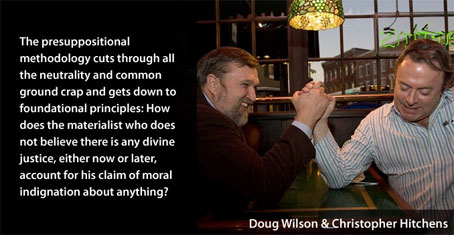
“The only panelist who really scored big points, in my opinion, was Doug Wilson. Rather than echoing the evidential arguments that his colleagues set forth, he argued at the presuppositional level. Hitchens never really answered him. In fact, I don’t think he knew quite what to do with his arguments.”
Previews at www.collisionmovie.com
Comments Off | tags: Atheism, Doug Wilson | posted in Apologetics
Apr
8
2009
“Salvation is a gift. Damnation is a paycheque.”
Comments Off | tags: Doug Wilson | posted in Biblical Theology, Quotes
Apr
8
2009
Mike Bull | 3 July 2007
In one sense, giving Richard Dawkins two weeks of air time on ABC TV’s Compass is like putting the tobacco companies in charge of lung cancer research.
In another sense, however, it is quite right that atheism is seen as just another faith. Dawkins’ ‘mount improbable’ illustration of evolutionary theory is really ‘mount impossible’, but he chooses to have faith in it, and admits elsewhere that it cannot be proven. (So much for the mountains of evidence he claims to have.) Evolutionary theory is just another of Dawkins’ ‘orbiting teapots’ that men choose to believe in.
Dawkins also wants us to believe that religious faith is intolerant and leads inevitably to killing. Yet he neglects to mention that his own faith gave us the most bloodthirsty century in history, the death toll estimated at around 100 million, many of them Christians, which is more than the deaths from all the ‘religious’ wars put together. The arbitrary human ‘Reason’ he extolls brought us the guillotine and unprecedented genocide. The hypothesis of evolution brought us eugenics and amplified racism. Christianity, however, brought us an end to slavery, the first hospitals, orphanages and social welfare, and not just because the founders happened to be Christian. These were and still are a direct result of a biblical worldview. Is it any wonder people are turning back to faith? Perhaps we have longer memories than Richard does. He’s like a doctor extolling the benefits of thalidomide to a pregnant woman in 2007. Is he ignorant or deceitful?
Richard argues from a supposed position of compassion and concern for those he ridicules, yet this is inconsistent with his materialistic worldview, and is simply borrowed capital from the Christian worldview he has turned his back on. The only reason he can slap God in the face is because he is standing in His lap. There is no basis in Richard’s worldview for any moral stand whatsoever. Remember, natural selection boils down to ‘might is right’. If we are all just biological accidents, or ‘nature’s way of keeping meat fresh’, perhaps religious killing is merely evolution in action.
Richard is also crafty in his lumping together of Islamic terrorists with Bible Christianity. I am sure he is aware that Baptists don’t fly planes into buildings or Presbyterians strap dynamite to themselves. Both Islam and Christianity have a mandate to dominate the world, but unlike the Koran the New Testament limits the weapons to proclamation, charity and self-sacrifice. Dawkins must know this.
It struck me as ironic that Richard thinks that teaching faith to our children is a form of child abuse, which includes neglect, black eyes, incest and being locked in the cupboard. However, his one-eyed little film displays many obviously happy Christian families, and the bitter ‘free-thinkers’ holed up in the woods appeared to be childless. A politically incorrect but undeniable biological fact is that his beloved secular west is becoming extinct through birth control, abortion and sodomy. If this is natural selection in action, it seems the meek will inherit the earth after all.
Comments Off | tags: Atheism, Compass, Islam, Richard Dawkins | posted in Apologetics, Creation
Apr
8
2009
Douglas Wilson on preaching to the whole man
In his great book The Abolition of Man, C. S. Lewis prophetically wrote of what has become one of the defining sins of our age. We veer erratically between two extremes — rationalism is arid and dry, and ultimately unsatisfying, and this provokes a reaction into swamp-like mysticism and emotionalism. Neo-classicism begets the rebellious child romanticism, and romanticism begets the rebellious child of a can-do technopoly. As we swing from one extreme to another, we miss the point of balance, which is that of having our affections under the authority of the God who made the world the way He did.
Lewis’ words are both blunt and revealing. He says we laugh at honor but then are shocked to find traitors in our midst. We castrate and bid the geldings be fruitful. The end result is what Lewis called “men without chests.” This has come about because an arrogant rationalism has dismissed all notions of sentiment, loyalty, and affection as “nothing but” mere sensation, without any objective connection to the outside world. This in turn provokes a revolt of the emotions, a revolt that wallows in those sensations, but does so in a way as to prove the point of the rationalists.
One of the chief culprits in allowing this state of affairs to develop has been the delinquency of the pulpit. Continue reading
Comments Off | tags: C. S. Lewis, Doug Wilson, Preaching | posted in Quotes
Apr
8
2009
“In those days there was no king in Israel.”
This is seen by some as a reference to the Davidic monarchy. Israel is in anarchy, and only a strong centralised state can help her. This is exactly the opposite of the message of Judges. Continue reading
Comments Off | tags: Humanism, Judges | posted in Biblical Theology
Apr
8
2009
“To try to generate good Church music out of the meager vocabulary of American popular music is like trying to generate good theology out of the ideas heard on Christian radio and television.”
–James B. Jordan, Symbolism: A Manifesto
Comments Off | tags: James Jordan, Music | posted in Quotes
Apr
8
2009
by Uri Brito
James Jordan makes some interesting remarks concerning scientific methods and the questions posed by science. [1] According to Jordan, modern scientific assumptions about the present betray the past and an accurate approach to the future. Science assumes that what we have today (referring to scientific discoveries) is exactly as it was in the past. However, scientific questions posed today are vastly different than the ones posed one hundred years ago. What Jordan is questioning with this reasoning is that science cannot be certain of its claims in the present, hence it must be seen with skepticism and understood for its limitations. When scientists claim certainty in their methods, they are in essence claiming ignorance of the lessons of the past and the future. Jordan writes:
The point of all of this is that the past is not subject to the kinds of controls and observation that science requires. Interpreting the past involves guesswork to a far greater degree than observational science, and thus there is far more room for presuppositions and assumptions to play a role. [2]
Jordan argues that unbelievers invariably are prone to wander in their scientific endeavors. Hence, “unbelieving ‘science’ does not perceive the true nature of the universe.” [3] Their worldviews restrain them from seeing biblical truth exchanging it for a lie. Jordan concludes that “when Christians operate on the same premises as unbelievers, they will not perceive aright either.” [4] Is it any wonder that natural theologians have begun to deny the historicity of the Creation account?
Jordan makes one further assertion worthy of consideration. He argues that Matthew 13 provides an excellent example of the intention of the Biblical record. According to our Lord, the parables were meant to reveal truth to believers and to deceive unbelievers. Jordan draws a similar parallel to revelation in creation. “If creational revelation is truly revelation, then it partakes of this same parabolic nature.” [5] As the written word misleads the faithless, so does the natural Word. Any approach that seeks to dispel the account of the Scripture is prone to self-deception.
___________________________
[1] James B. Jordan, Chapter 6, Creation in Six Days: A Defense of the Traditional Reading of Genesis One
[2-4] Jordan, p. 126
[5] Jordan, p. 127
Comments Off | tags: Biblical worldview, James Jordan, Uri Brito | posted in Creation, Quotes
Apr
8
2009
or Scriptura sub scientia
The Sydney Anglicans are rightly respected for their stand on biblical authority. But in a recent publication, they call for seeing Genesis as ‘figurative’. Continue reading
Comments Off | tags: Genesis, Tas Walker | posted in Creation
Apr
8
2009
 An examination of the teachings of Jesus on eschatological issues. Also, a look at the dating and interpretation of the Book of Revelation.
by W.A. Young, Jr. Th.D. Covenant Theological Seminary www.trinityreformed.com
Nothing is more interesting than the study of what is referred to as the end-times. Nothing sells books, tapes, or videos like future prophecy. Preoccupation with the future is what sells horoscopes, palm readings, and the like. We all face the fears and hopes of what the future may bring. People want to know what will happen in the end.
The purpose of this paper is to review the nature of eschatology. There has been a major shift in eschatological perspective that has swept through much of evangelicalism today. This has occurred in the last one hundred to one hundred and fifty years. It has both violated and permeated much of the church’s teachings concerning the end of this age.
My own journey, especially during the early formative years, was one of vacillation. In the early days, I subscribed to the majority report among evangelicals, the dispensational view. This view is characterized by Hal Lindsey and others. Dispensationalism came about in the 1830′s and is built on the futurist system and supported by the Scofield Bible. It dominates evangelical preaching, education, publishing, and broadcasting today. I suspect the reason is that Scofield presents such a systematic approach that an individual can easily subscribe because it is so easily laid out in his footnotes. As I have grown in my understanding of scriptures I have come to see that the moderate Preterist perspective best presents the biblical perspective. This view is what is under consideration in this paper. Continue reading
Comments Off | tags: David Chilton, Eschatology, Kenneth Gentry, Preterism, Revelation, Scofield Bible, Temple | posted in The Last Days
Apr
8
2009

“The Kingdom of God is not advanced through politics and ideology, but through proclamation and charity.”
–James B. Jordan
Comments Off | tags: Gnosticism, Ideology, James Jordan | posted in Quotes