Apr 8 2009

Heart Affection

“If ye, then, be risen with Christ, seek those things which are above, where Christ sitteth on the right hand of God” (Colossians 3:1).

Spiritual hunger and thirst are fulfilled in the Lord Jesus, while at the same time they are enlarged for more of Him. This satisfaction overwhelms all lesser longings. Fleshly yearnings are never fulfilled, and every attempt at such satisfaction soon cloys.

“Do we think of, and rejoice in, our blessings more than in the Person in whom we have them? As to even our doctrinal blessings, there is a wonderful charm about them when they are new to us, and they sustain the soul for a certain time; but when the first joy of them passes away, a settling-down process commences. Every new bit of blessing may seem to put a new bit of life into us, but it gradually loses its luster and power, and we become just ordinary Christians–we make very little progress.

“It is as we take the Lord Jesus by faith into the affections of our hearts that we make spiritual progress. It is as He occupies an enlarged place in our affections that we go on. The head may be filled with general theological information without producing one spark of heart-affection for the Lord Jesus, and the soul remains in a state of spiritual emaciation.”

“Many have been misled by thinking that by reading the Bible you become like Christ–transformed; but you will find diligent students of the Word, who may never say anything incorrect in doctrine, yet who never seem to grow in grace and walk in spiritual reality.”

“All blessings of this dispensation of grace are wrapped up in a Person, and, by means of the Word of God, we make spiritual progress as our hearts learn to find everything in Him–the Son of God who loved us and gave Himself for us.”

“He satisfieth the longing soul, and filleth the hungry soul with goodness” (Psalm 107:9).

from None But The Hungry Heart, compiled by Miles J. Stanford
www.withchrist.org

Share Button

Apr 8 2009

Maintaining a Spiritual Glow

by a Wesleyan Missionary (updated)

Keep a restful heart. Hurts, slights, frustrations, misunderstandings, differences of opinions, or unhappiness with God’s providences—may quickly ferment into resentments, critical feelings, and bitterness of spirit—which in turn bubble over in words that cut and bruise.

To avoid this, I determine to drop each disturbing thing at the foot of the Cross, appropriating the healing of Christ’s cleansing Blood, and accepting each unwanted thing as His choice for me, remembering that “…God…maketh my way perfect” (Psalm 18:32). Thus shall His peace and rest prevail (1 John 1:9; 1 Peter 5:7; 1 Thess. 5:18).

Operate on the basis of short accounts with God and man. At the earliest awareness of a fault, a failing to measure up to the Divine will for me—being too earthly minded, God’s kingdom and righteousness not of first importance, carelessness about some duty, words unkindly spoken, a temper of heart toward anyone that is not of love—I will, humbly seeking His forgiveness and enabling, measure up to whatever adjustments He designates.

By vigilance and obedience keeping the heavenly connection clear, I shall maintain the spiritual glow that permits God to flow constantly through my life in revival.

Saturate myself with God’s Word. I shall be judged by this Word (John 12:48). Faith is strengthened and stimulated by the Word (Rom. 10:17). God reveals Himself through the Word, and its knowledge will make me a better witness. Therefore, I shall give it, with prayer, top priority in my daily schedule (Psa. 119:11, 105,130).

Develop my prayer time beyond the “gimme” stage. I purpose to enter more fully into the joys of worship and fellowship with the Lord, allowing Him to talk to me, too (John 4:23,24; Psa. 27:14; 1 John 1:3-7).

Let God use me. My hands, my strength, my possessions, my sympathy, my friendliness, my interest in and concern for those I contact—I will keep submitted to God as channels for revealing Himself to others.

Give as God directs. I will give as much as He chooses, and seek His will as to where He wants it to be used (2 Cor. 9:6-15).

Love. My goal shall be to love my God with an undivided heart and my fellowmen out of “a pure heart fervently” (1 Peter 1:22), because I allow His love to spill itself out through my day by day life (Rom. 5:5).

Share Button

Apr 8 2009

The Collision of God and Sin

“Who His own self bare our sins in His own body on the tree.” 1 Peter 2:24

The Cross of Jesus is the revelation of God’s judgment on sin. Never tolerate the idea of martyrdom about the Cross of Jesus Christ. The Cross was a superb triumph in which the foundations of hell were shaken. There is nothing more certain in Time or Eternity than what Jesus Christ did on the Cross: He switched the whole of the human race back into a right relationship with God. He made Redemption the basis of human life, that is, He made a way for every son of man to get into communion with God.

The Cross did not happen to Jesus: He came on purpose for it. He is “the Lamb slain from the foundation of the world.” The whole meaning of the Incarnation is the Cross. Beware of separating God manifest in the flesh from the Son becoming sin. The Incarnation was for the purpose of Redemption. God became incarnate for the purpose of putting away sin; not for the purpose of self-realisation. The Cross is the centre of Time and of Eternity, the answer to the enigmas of both.

The Cross is not the cross of a man but the Cross of God, and the Cross of God can never be realised in human experience. The Cross is the exhibition of the nature of God, the gateway whereby any individual of the human race can enter into union with God. When we get to the Cross, we do not go through it; we abide in the life to which the cross is the gateway. The centre of salvation is the Cross of Jesus, and the reason it it so easy to obtain salvation is because it cost God so much. The Cross is the point where God and sinful man merge with a crash and the way to life is opened—but the crash is on the heart of God.

–Oswald Chambers

Share Button

Apr 8 2009

Worth Fighting About

The type of religion which rejoices in the pious sound of traditional phrases, regardless of their meanings, or shrinks from “controversial” matters, will never stand amid the shocks of life. In the sphere of religion, as in other spheres, the things about which men are agreed are apt to be the things that are least worth holding; the really important things are the things about which men will fight.

–J. Gresham Machen 

Share Button

Apr 8 2009

Yield to the Book

“(Adoniram) Judson was a lover of the Word of God. The main legacy of his 38 years in Burma was a complete translation of the Bible into Burmese and a dictionary that all the later missionaries could use. Once when a Buddhist teacher said that he could not believe that Christ suffered the death of the cross because no king allows his son such indignity, “Judson responded, ‘Therefore you are not a disciple of Christ. A true disciple inquires not whether a fact is agreeable to his own reason, but whether it is in the book. His pride has yielded to the divine testimony. Teacher, your pride is still unbroken. Break down your pride, and yield to the word of God.’”

John Piper | How Few There Are Who Die So Hard! Suffering and Success in the Life of Adoniram Judson: The Cost of Bringing Christ to Burma
www.desiringgod.org/ResourceLibrary/Biographies

Share Button

Apr 8 2009

How To Reach Post-Everythings

Tim Keller asked the following question to his denomination:

“How do we, as a denomination, do renewal and outreach in the emerging post-everything United States culture? ‘Post-everything’ people are those who are now in their teens and twenties—and they are our future.”

In his brief article, Keller lays out six issues at stake in engaging this group and how Reformed theology offers the resources to address these issues:

Issue: Post-everythings like narrative and story Continue reading

Share Button

Apr 8 2009

Saul meets Ananias

Here is the murderer of Christians, sitting in darkness, realising that he has been wrong. He hears footsteps. A Christian has come to see him, and the first word he hears from the people he has been persecuting when he is at their mercy is “Brother”.

Mark Loughridge

Share Button

Apr 8 2009

Ordinary People

“It is a serious thing to live in a society of possible gods and goddesses, to remember that the dullest and most uninteresting person you can talk to may one day be a creature which, if you saw it now, you would be strongly tempted to worship, or else a horror and a corruption such as you now meet, if at all, only in a nightmare.

All day long we are, in some degree, helping each other to one or the other of these destinations. It is in the light of these overwhelming possibilities, it is with the awe and circumspection proper to them, that we should conduct all our dealings with one another, all friendships, all loves, all play, all politics. There are no ordinary people. You have never talked to a mere mortal…

Next to the Blessed Sacrament itself, your neighbour is the holiest object presented to your senses. If he is your Christian neighbour, he is holy in almost the same way, for in him also Christ vere latitat – the glorifier and the glorified, Glory Himself, is truly hidden.”

C. S. Lewis, The Weight of Glory: And Other Addresses

Share Button

Apr 8 2009

The Lost Ark

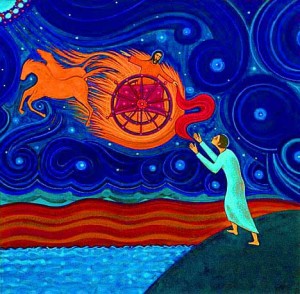
elijahascendsThey sent therefore fifty men. And for three days they sought [Elijah] but did not find him. And they came back to [Elisha] while he was staying at Jericho, and he said to them, “Did I not say to you, ‘Do not go’?” (2 Kings 2:17-18)

It seems the Ark was “taken” like Enoch. If it was carried to Babylon, perhaps it was melted down with other conquered “gods” to contribute to Nebuchadnezzar’s “golden calf.” It fits the pattern if the Ark “died” on the altar of false worship “outside the city.” Continue reading

Share Button

Apr 8 2009

The Altar of the Abyss – 1

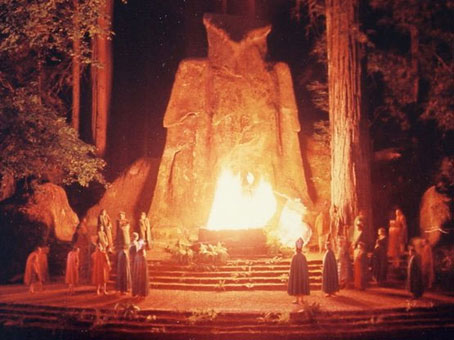
molech2During the Creation week, there were three days of forming new “empty spaces” by dividing the original watery deep (the Abyss), then three days of filling them. A ‘world model’ develops with God’s throne at the top and the Abyss at the bottom, the place furthest from the throne. The architecture of the Tabernacle follows this model, laid out upon the ground.

When the priesthood – the Land-mediators – disobeyed God, the Abyss was dredged up to cover the Land (holy place). We see this first in the flood, and later in the invasions of Assyria, Babylon and Rome.

The Valley of Hinnom became a symbol of the ‘Abyss’ below the true mountain of God. As an evil twin of the holy place, it was an ‘Adamic’ clay pit with no glorious metal. It was also the place where Judah sacrificed their infants to false gods. It was counterfeit worship in the tabernacle of hell, and the Lord said He would fill it with their bodies. Their dark ‘table of showbread’ became a snare. [Read Jeremiah 19]

After the Babylonian captivity, Zechariah saw the church in “the deep” (often translated valley or glen). A new Land-altar was rising out of the ‘waters’ – a new mountain of God, with a new Eden-temple to mediate for the world.
TAOTA

Share Button