Apr
10
2009
 or ‘How to Raise Monsters’
Peter Leithart points out that the very early verses in John’s gospel can be corresponded with the Creation week:
DAY 1: The Light of the World (1:1-18)
DAY 2: The Baptism of John (1:19-28)
DAY 3: Jesus’ Baptism (1:29-34): dry land emerges from water, “the next day.”
DAY 4: John Points Disciples to Jesus (1:35-39)
DAY 5: Disciples Bring Brothers (1:40-42)
DAY 6: Jesus and Nathanael (1:43-51): “the following day,” the first day
DAY 7: [nothing]: Sabbath; the second day
DAY 8: The Wedding at Cana (2:1-11): “the third day”
More detail here.
It seems to be the case with many Bible books that they start off with a small seven, which is part of a larger one, which is then part of a great seven that structures the book (among other internal structures).
As with Matthew’s gospel, the next level in John covers the first few chapters, and might even solve a textual difficulty:
Continue reading
Comments Off | tags: Creation Week, Daniel, John, Peter Leithart, Priesthood, Typology | posted in Biblical Theology
Apr
10
2009
Counter-FEET
The gospel was on its way to conquering the Roman empire. Jewish persecution had failed (read Acts). A flood of false doctrine had failed (read the later epistles for the fight). So Satan used persecution from a Jew-Gentile conspiracy to persecute the new church.
The thought is this:
The feet of the statue in Daniel 2 became Satan’s answer to the by-now successful “intermarriage” of Jews and Gentiles in one body, the Christian church. As a Jew-Gentile conspiracy, the metal man became an evil twin of Paul’s Jew-Gentile Tabernacle. With unclean feet of Roman iron intermarried with Edomite (red) clay, Judaism became the church of Esau.
(For more, see Esau’s Ladder).
Comments Off | tags: Compromise, Daniel, Genesis, Satan | posted in Biblical Theology, The Last Days, Totus Christus
Apr
10
2009

“I could never believe a book that starts with a talking snake!”
The fourth beast was stronger and more terrifying than the others. Its huge teeth were made of iron, and what it didn’t grind with its teeth, it smashed with its feet. It was different from the others, and it had horns on its head – ten of them. Just as I was thinking about these horns, a smaller horn appeared, and three of the other horns were pulled up by the roots to make room for it. This horn had the eyes of a human and a mouth that spoke with great pride. Daniel 7:7-8
The Bible begins with Adam, Eve and a serpent in the garden, and ends with a false prophet (Adam), harlot (Eve) and beast (serpent) squatting in God’s house. The seed of man’s rebellion was now a fullgrown tree – a tree of death (James 1:14-15).
Animals are the tutors in the Old Testament. Man was created in God’s image, but instead imaged a beast. Adam was covered in animal skins and their blood temporarily covered his sin. The law was administered by angels, and the symbols God uses are mostly animals. As mentioned in a previous post, the three major covenants were symbolised by an ox, a lion and an eagle. The New Covenant symbol is the Man who is bread and wine. The New Covenant era is administered not by angels but by men, Christians.
But as this New Covenant era arrived, so did a false man: a being who had the eyes and mouth of a man but was really a man-mask for the Roman beast. Revelation refers to Jews as ‘men’ because, like Noah, they were the mediators. The gentiles are the ‘beasts’ who are called to submit and enter the ark of Christ (Acts 10:11-12).
As Israel’s history completed Day 6 (the Land animals and the Man predicted in Daniel 7), this false man, a beast who spoke like a man, was squatting in God’s garden. The Herodian line was a talking snake.
You can trust the Bible. There is always method in any apparent madness. God doesn’t do or allow anything without a reason.
(Balaam the false prophet was also a ‘talking snake.’ He was blind to God’s word, so God used a talking donkey to get through to him.)
Comments Off | tags: Angels, Balaam, Daniel, Genesis, Typology | posted in Biblical Theology, Creation, The Last Days
Apr
10
2009
“A river of fire was flowing and coming forth from before him…”
Daniel 7:10
This aspect of the vision points us back to Jacob’s ladder, which had angels ascending and descending upon it (Genesis 28:12). These are angels who bear the flaming sword of Genesis 3, which bars mankind from paradise, but which also mediates between God and mankind when it comes down from His throne to light the fire on His earthly altar (Leviticus 9:24; 2 Chronicles 7:1). Fulfilling the prophecy, it is the fire that came down from Jesus on the day of Pentecost to light the fire on His new altar-people (Acts 2), which is pictured again in Revelation 8:3-5.
James B. Jordan, The Handwriting on the Wall, p. 392.
Available from www.americanvision.org
Comments Off | tags: Daniel, James Jordan | posted in Biblical Theology, Quotes
Apr
10
2009
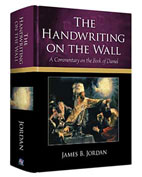
No Bible commentary is the last word, but James Jordan’s seven-year effort gets the ball through the hoop on Daniel. Here’s an excerpt from David Field’s review:
The approach of the book is marked by
 1. Immersion in and informed reference to the rest of the Hebrew Scriptures. The use of Genesis, Exodus, Leviticus, Ezra-Nehemiah, Esther, Isaiah, Jeremiah, Ezekiel, and Zechariah is astonishing and enriching at every turn. Use of or comment upon other books along the way are unfailingly stimulating and this applies to NT books as well, not least to Revelation which is greatly illumined by this work on Daniel.
2. Confident deployment of redemptive-historical paradigms which have themselves been recognized through close and repeated study of the whole Bible. In particular, theologico-spatial zones, old creation /new creation eras, and prophet /priest /king roles feature heavily and often have real power to unlock or clarify the subject in hand.
3. The closest of close structural analysis of the sort that comes from multiple readings. Chiasms and parallels and other patterning devices are attended to with great care and in such a way as positively informs the interpretation rather than being mere observations along the path.
4. Seriousness about chronology. This is one of the characteristics of Jordan’s work overall, since he sees emphasis on “ideas” at the expense of history as revealing and strengthening the gnosticism of much contemporary Christianity. The detailed chronological work lying behind his interpretation of Jeremiah and Ezekiel and his resolution of some of the Daniel “difficulties” is awesome.
5. Interpretative weight given to what still gets called “inter-testamental” history. Inter-testamental history is redemptive history and Jordan emphasizes that God speaks to and about that period in the patterns of Daniel 1-6 and in the prophecies of Daniel 1-7.
6. Attention to numerics: word-counts, significant numbers, and the meaning of numbers. There is work here to compare with Bauckham’s work on Revelation.
7. Typology. This is not a “typological” commentary as such because although half of Daniel is narrative, half of it is apocalyptic prophecy. But when you attend to redemptive-historical patterns and to literary structures and sequences and to the importance of history as Jordan does, then, in some sense, all your work will be typological. At the macro-historical this means that Daniel is one of God’s major interpretative words for the entire second phase of the first creation. The first creation has a former days and a latter days and then gives way to the new creation. Daniel tells us about the last centuries and decades of the latter days of the old world.
8. Cheerful (and sometimes curmudgeonly) unfashionableness. Early dating, traditional authorship, defense of biblical chronology, unashamed constant reference to Christ (how could it be otherwise?!), impatience with “unbelieving scholarship”, utter lack of interest in being respected and consistent resolve to be useful. This may be a difficult example for young scholars (like those in Daniel 1!) to follow but it is thoroughly refreshing.
9. Theological creativity at level “Genius”. I thought I knew Jordan’s work reasonably well but over and over and over again there are “aha!” moments. In my copy now there are almost more sentences and paragraphs marked than unmarked!”
“The Handwriting on the Wall” is available from www.americanvision.com
Also available as an e-book.
Comments Off | tags: Apocalyptic, Bible Chronology, Bible history, Book Review, Daniel, David Field, James Jordan, Typology | posted in Biblical Theology
Apr
8
2009
“…and I came to Jerusalem and discovered the evil that Eliashib had done for Tobiah, in preparing a room for him in the courts of the house of God. And it grieved me bitterly; therefore I threw all the household goods of Tobiah out of the room. Then I commanded them to cleanse the rooms; and I brought back into them the articles of the house of God, with the grain offering and the frankincense.” Nehemiah 13:7-9
After the failure of Israel’s kings and their adulterous priesthood, God established new worship in the “wilderness” of Babylon under Daniel and Ezekiel. When Babylon fell, He brought His new Jerusalem, like a pure bride, back to the mountain of God.
Continue reading
Comments Off | tags: Apostasy, Compromise, Daniel, Ezekiel, Ezra, Man of sin, Nehemiah, Priesthood | posted in The Restoration Era
Apr
8
2009
There is a lot of truth in theonomy. But things have changed since the time of Moses. At that point, the church and state were basically one.
After the exile, things were different. The role of the Jews was to be priests within the Gentile state. They no longer had the right to administer capital punishment. When they witnessed faithfully, there was a Jew at the emperor’s right hand, steering the empire for God’s people and their stand for the truth.
Continue reading
Comments Off | tags: Abel, AD70, Daniel, Haman, Joseph, Mordecai, Theonomy, Witness | posted in Biblical Theology, Ethics
Apr
8
2009
The book of Daniel begins with the captured vessels from Solomon’s Temple being carried off to Babylon. We assume the ark, with its solid gold lid, was melted down. The golden lampstand, however, shows up at Belshazzar’s feast just before the fall of Babylon to Persia. Cyrus decrees that the Jews can return and rebuild the Temple. They carry the vessels, minus the Ark, across the Great River Euphrates.
Zechariah later sees a flying scroll with the dimensions of the Tabernacle (10 x 20 cubits). These are also the dimensions of the Ark plus cherubim in Solomon’s Temple. The Ark had been offered as an ascension and created a new heaven – unrolled a new scroll. The Restoration Covenant cost the Ark its “life.”
Now to Acts. The human Ark, Jesus, had ascended to heaven and left the “seven churches”, the New Covenant Lampstands with tongues of fire, to rule and conquer Babylon (Jerusalem). The church did so, and we see the firstfruits church army, the “kings from the sunrising” crossing the Great River in Revelation 16, entering a new earth like Joshua over Jordan.
Comments Off | tags: Ark of the Covenant, Babylon, Daniel, Exile, Lampstand, Revelation, Stephen, Tabernacle, Temple, Zechariah | posted in Biblical Theology, The Last Days
Apr
8
2009
“Even if Noah, Daniel, and Job were living in that nation, their faithfulness would not save anyone but themselves. …even if Noah, Daniel, and Job were living there, I, the Lord, promise that the children of these faithful men would also die. Only the three of them would be spared.” (Ezekiel 14:14, 20)
 The mediation of even the holiest men would not avert God’s judgments. Noah had failed to prevent the destruction of the old world. Daniel had failed to prevent the destruction of the Land. Job had failed to prevent the destruction of his children. Like the three domains under these men, Jerusalem was beyond deliverance. And even if these holy watchmen were present in Jerusalem, they alone would be saved. These three only would be rescued from Sodom like Lot. In chapter 23, Ezekiel refers to Jerusalem as Sodom. Jerusalem the oppressor was also like Egypt. As the Land symbolically had four corners, four judgments would desolate it: sword, famine, beasts and pestilence, the Covenant curses from Leviticus 26. This was the Levitical sword indeed. The exiles, as watchmen, would see the repentance of the “marked” survivors and know that the Lord had not acted without cause.
Comments Off | tags: Daniel, Egypt, Ezekiel, Job, Noah, Sodom | posted in Biblical Theology, Totus Christus
Apr
8
2009
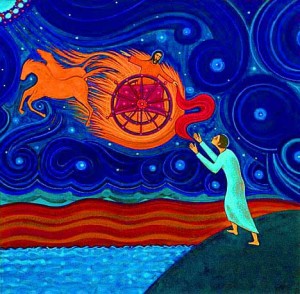 They sent therefore fifty men. And for three days they sought [Elijah] but did not find him. And they came back to [Elisha] while he was staying at Jericho, and he said to them, “Did I not say to you, ‘Do not go’?” (2 Kings 2:17-18)
It seems the Ark was “taken” like Enoch. If it was carried to Babylon, perhaps it was melted down with other conquered “gods” to contribute to Nebuchadnezzar’s “golden calf.” It fits the pattern if the Ark “died” on the altar of false worship “outside the city.” Continue reading
Comments Off | tags: Ark of the Covenant, Babylon, Daniel, Elijah, Elisha, Enoch, Jericho, Jezebel, Lampstand, Michael O'Brien, Nebuchadnezzar, Revelation, Zechariah | posted in Biblical Theology, The Restoration Era, Totus Christus