Dec
31
2010
Just watched the movie Gattaca again (with daughter Olivia). It begins with a couple of quotes, one of them being:
“Consider the work of God; For who can make straight what He has made crooked?” Ecclesiastes 7:13
This is one of those movies that delivers more upon repeated viewings.
Continue reading
Comments Off | tags: Culture, Doug Wilson, Film, James Jordan | posted in Biblical Theology
Dec
30
2010
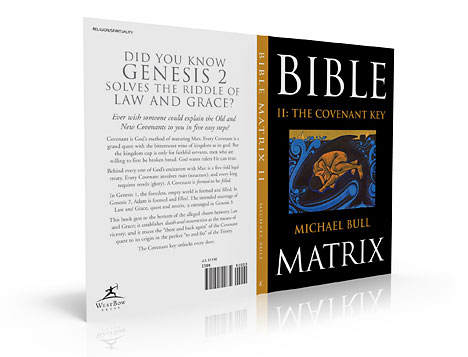
Did you know Genesis 2 solves the riddle of Law and Grace?
Continue reading
7 comments | posted in Bible Matrix, Biblical Theology
Dec
29
2010
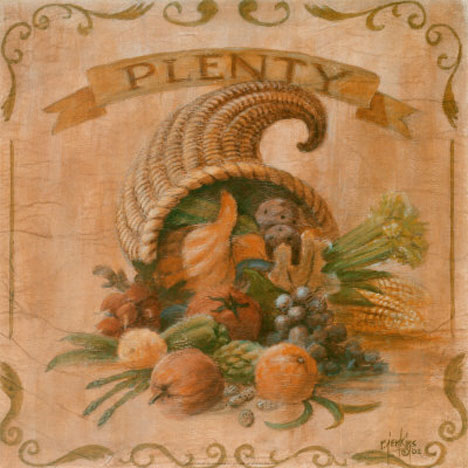
The Table on God’s Mountain
“Most assuredly, I say to you,
unless a grain of wheat
falls into the ground
and dies,
it remains alone;
but if it dies,
it produces much grain.”
John 12:24
Israel was given a “firstfruits” taste of the Promised Land in Numbers 13. As with all Covenants, it was bittersweet. There were grapes, but there were giants. It was the same challenge as the one given to Adam. They were called to be judges who made their decisions based not on sight, but on faith in God’s Words.
Continue reading
Comments Off | tags: Isaiah, Joshua, Numbers, Peter Leithart, Zechariah, Zerubbabel | posted in Bible Matrix, Biblical Theology, The Last Days, The Restoration Era
Dec
28
2010
“Who may ascend into the hill of the LORD?
Or who may stand in His holy place?
He who has clean hands and a pure heart…” (Psalm 24:3-4)
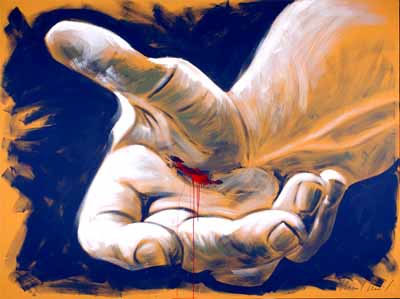
In Leviticus, an Israelite is to lay his hand on the sacrifice that covers his sin and allows him to draw near to God. It was the red hand of death and the whiteness of a pure sacrifice willing to take the “stroke” (plague).
“And Abraham stretched out his hand and took the knife to slay his son.”
Genesis 22:10
But the Lord Himself covered Moses with His hand as the consuming fire of His glory passed-over the mountain. It was the hand of life and the whiteness of imparted glory. As far as was possible, Moses saw the Lord as He was, because he was like Him.
Continue reading
Comments Off | tags: Abraham, Genesis, Leviticus, Moses, Passover, Revelation, Typology | posted in Biblical Theology, Totus Christus
Dec
27
2010
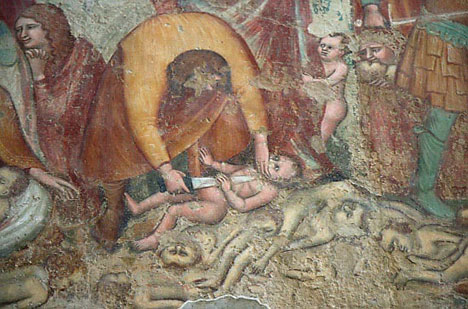
A Christmas sequel to Joseph Gets Passed Over.
The subject matter of this article was corrected, revised, and expanded in December 2018 and published here: Matthew 2: Jerusalem as Egypt.
1 comment | tags: AD70, Add new tag, Altar of the Abyss, Christmas, Gehenna, Herod, Literary Structure, Matthew | posted in Bible Matrix, Biblical Theology, Totus Christus
Dec
19
2010
Comments Off | posted in Biblical Theology
Dec
16
2010
“Then Jesus told them: You can be sure that tax collectors and prostitutes will get into the kingdom of God before you ever will! When John the Baptist showed you how to do right, you would not believe him. But these evil people did believe. And even when you saw what they did, you still would not change your minds and believe.” (Matthew 21:31-32)
James Jordan teaches you to observe the universals in Scripture. I believe one of the most important is the Totus Christus pattern, head and body, and its counterfeits and distortions.
As mentioned around here a couple times (sorry, a couple of times. I’ve been reading too many Americans), the curse upon Adam concerned his head, and his responsibility to provide for and protect the body. The curse upon Eve concerned her body, her role in producing offspring. Both curses were a limited form of barrenness.
But what of the relationship between head and body? James Jordan writes:
Continue reading
2 comments | tags: Abortion, Altar of the Abyss, Covenant curse, Covenant Theology, Doug Wilson, Genesis, James Jordan, Marriage | posted in Biblical Theology, Quotes, The Last Days, Totus Christus
Dec
16
2010

A short review of Bible Matrix by Jared Leonard on goodreads.com… Continue reading
1 comment | posted in Bible Matrix, Biblical Theology
Dec
14
2010
 .
.
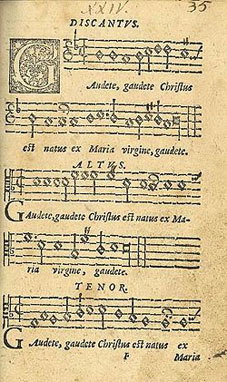
Rejoice, rejoice! Christ is born
Of the Virgin Mary — rejoice!
The time of grace has come—
This that we have desired,
Verses of joy
Let us devoutly return.
God has become man,
To the wonderment of Nature,
The world has been renewed
By the reigning Christ.
The closed gate of Ezechiel
Is passed through,
Whence the light is born,
Salvation is found.
Therefore let our gathering
Now sing in brightness
Let it give praise to the Lord:
Greeting to our King.
Continue reading
1 comment | tags: Christmas, Music | posted in Biblical Theology
Dec
14
2010
or God is a Foodie
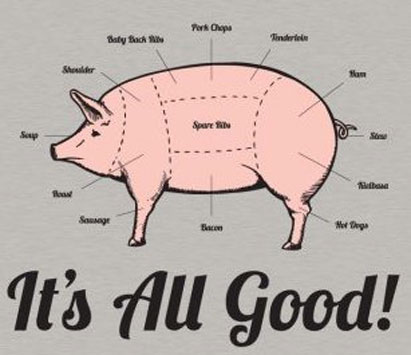
The Mosaic dietary laws were temporary. Just as a Nazirite made a temporary vow for the purpose of sanctification for holy war, so Israel’s purpose as a nation of holy warriors included certain abstinences prescribed by God. Once the war was over, the prohibitions were removed. “Bridal food” (the Feast of Tabernacles) was back on the menu in the first century.
The Nazirite vow was a symbolic form of death and resurrection, of the bridegroom going into the grave (short hair), slaying the serpents, and emerging from the chamber with His bride (long hair), whom He then presented to the Father. [1] The prohibition on the Tree of Knowledge was a temporary one. It began Adam’s holy war, but he broke the vow, failed to rescue the bride and was expelled from the Lord’s table. [2]
Continue reading
11 comments | tags: Communion, Fasting, Food laws, Genesis, Jacob, James Jordan, Leviticus, Nazirite, Robert Farrar Capon, Typology | posted in Biblical Theology, Christian Life, Quotes