Feb
1
2010
Heart of Glass

Peter Leithart writes:
Solomon’s temple had windows, but they are mentioned only once, in 1 Kings 6:4. Ezekiel’s description of the visionary temple uses the word “window” twelve times.

Peter Leithart writes:
Solomon’s temple had windows, but they are mentioned only once, in 1 Kings 6:4. Ezekiel’s description of the visionary temple uses the word “window” twelve times.
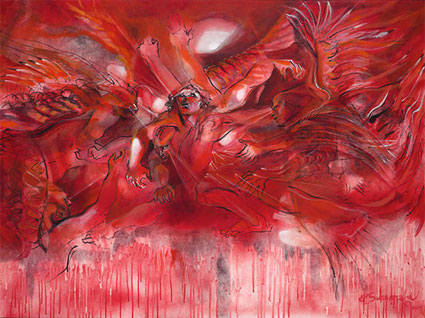
How are we to understand the need for Jacob to wrestle not only with Laban, but also with the angel of the Lord?
Abraham was given a miraculous son and his greatest test was to face the loss of that promised son. Jacob’s test was a similar loss of what had been gained through unity with God by Covenant. Both Abraham and Jacob had learned that they were not lords themselves but stewards under the Lord. Their authority was delegated to them. They were “Word incarnate.” Theirs was the authority of a head servant. They were Covenant vassals, and what was truly precious was their faithful relationship to God under this Covenant. Continue reading

36. Acording to Preterists, all those left in Jerusalem were reckoned unholy. But see Isaiah 4:3-4.
Simple answer: Isaiah 4 refers to the “new Jerusalem” of Ezra and Nehemiah. But I’m going to use this as an opportunity to analyse Isaiah 4 and its context. This stuff blows me away.

A gripping sermon from Doug Jones in 2007. He contrasts unitarian and trinitarian worldviews.

In Envy and the Sons of God, I wrote:
…those with the title “the sons of God” in Job were not angels but priestly, mediatorial men (an observation I have heard from Gary DeMar). Satan envied them, accused them, as he always does. They are Adams in the garden, Covenant heads, and he hates them. Job was a priest-king.
DeMar has also just published an article on Job in the last few days that deals with the crazy angel/human hybrid Nephilim theory, and of necessity covers the identity of the sons of God.
 “My God, it’s full of stars!”
One of the reasons I appreciate James Jordan is his ability to identify the “universals” in Scripture. Understanding these recurring themes answers many questions and solves many mysteries. These universal “roles” and events all point forward to the events of the first century. For instance, we cannot understand what the apostles meant by the phrase “the sons of God” without checking its history in the Old Testament. [1]
The danger with dealing in all the “big picture” stuff is that it can become self-serving. The heart is deceitfully wicked, and theology can become a kind of escapism, an ideology. Like the worst of the 20th century’s political ideologies, it can be divorced from reality so that in practice it rides roughshod over people to achieve its goals. Any big theology must maintain a big pastoral heart.
[This post has been refined and included in Sweet Counsel: Essays to Brighten the Eyes.]
Continue reading
31. The remnant of Israel still practices iniquity (Zeph. 3: 13).
Drew was right. Some of these really are weak. Zephaniah denounces Judah for her indulgence in idolatry and luxury while she presumed the Lord would protect her. He predicts a new Jerusalem without these sins. All fulfilled. Ripping the prophets out of context and applying them to modern “Jews” is not only infantile exegesis, it removes most of the Bible from the real world so it can apply to some future Jews. God doesn’t work that way. He warns, waits a generation, then judges. Always. Same thing goes for the Revelation.
26. Christ returned in A.D. 70 (?), but according to preterists the literal cloud was missing (see Acts 1: 9; Matt. 24: 30; Rev. 1: 7).
The “Bible matrix” pattern always begins with a Word from God’s glory cloud on the Lord’s Day (Sabbath), the accepted Mediator received into this single-cloud “Tabernacle” (Firstfruits) and ends with multiple clouds, a corporate Mediator (the body). The Feast of Tabernacles (“succoth”) is literally the Feast of Clouds. This was fulfilled in AD70. Christ ascended to prepare the place, and the firstfruits church was received into it at the destruction of the Temple.
See also Not Just Any Old Cloud.
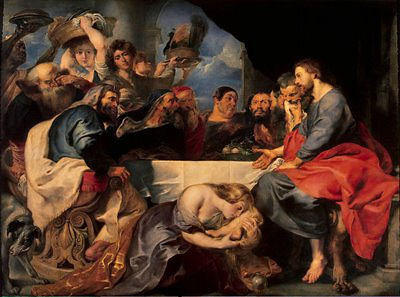
Here’s a charming quote discovered and posted by Doug Wilson over a year ago. Being exactly the opposite of the so-called “party” image portrayed on TV and in glossy mags, it kind of stuck with me. It is not sinful like they are, yet it is so “incorrect” that it must be true.
The Bible is full of food and money, and not just because God speaks to us using things we understand. Eating and working and spending wisely are glorifying to God. Our economics flows from our worship. Cultus begets culture, always. Doug Wilson writes:
.
Our nation’s public economists usually refer to you in your capacity as consumer. This is in contrast to previous and wiser eras, when citizens were thought of as producers, and as savers. But we have departed from the way, and when disaster strikes, one of the things we think to do, is spend our way out of it. Republicans want to spend out way out this way, and Democrats that way, but we all think that consumption is king. Our understanding of consuming has become deranged.




 Bible Matrix blog