Jun
8
2009
or Touch Not, Taste Not, Handle Not II
The dietary Laws given to Moses were an expansion of the command given to Adam. It is the self-denial of priestly obedience to God. Adam wasn’t ready for the tree of judicial responsibility (kingdom) but he seized it.
In the greater Bible picture, Israel’s history (from Moses) is this period of priestly obedience. But Jesus came and reversed Adam’s failure. Consequently the dietary laws are revoked, and with greater maturity, the people of God (through the first century death of Israel and her resurrection as the church) now, like Jesus, have the judicial wisdom of the Spirit, and the power to eat unclean things (Gentiles), consume them and make them clean. Only the power of resurrection can enter a room with a corpse in it, touch lepers and feast on Gentile meats and not be made unclean, but instead make the unclean clean by consuming it. This is the power of the New Covenant.
Continue reading
Comments Off | tags: Babylon, Crystal Sea, Daniel, Esther, Food laws, Postmillennialism, Priesthood, Resurrection, Scavengers, Tabernacle | posted in Biblical Theology
Jun
7
2009
A couple of brave readers of my book Totus Christus have pointed out an apparent discrepancy in my ordering of the above three roles. One kindly writes:
The only question of substance I have for you concerns the prophet, priest and king flow of OT history. It may be that you disagree with Jim, but he’s quite insistent that the proper order is priest, king, prophet. He discusses this in From Bread to Wine, p. 9-15. In any case, it might be helpful to explain why you deviate…
Continue reading
Comments Off | tags: Aaron, David, Dominion Theology, High Priest, James Jordan, Moses, Music, Solomon | posted in Biblical Theology, Totus Christus
May
30
2009
A House of Bread
There are two kinds of whiteness in the Bible, and an understanding of this explains a great deal. There is the whiteness of covering and the whiteness of uncovering. And, as mentioned, the Bible makes a great deal out of the concept of covering.
Bone Collector
Purge me with hyssop, and I shall be clean; Wash me, and I shall be whiter than snow.
Touching a corpse made an Israelite unclean. The remains of those slain in battle were marked with lime for two reasons: so that they could be avoided by the clean, and so they could be gathered up and burned to lime by the bone collectors. Jesus said that the righteousness of the Pharisees was like a whitewashed sepulchre. Not only were they full of the ceremonial uncleanness of broken Covenant, their so-called righteousness was actually a mark from God upon them. They would be gathered to their people not by the Father sending His angels to the four corners of the Land, but by the father of lies and his scavengers sent by God to clean the wound.
This image goes right back to Genesis. Like the angels, the Covenant scavengers, though demonic, are also God’s servants. They are the raven of Noah surviving on floating corpses until the water goes down; they are the scavenging dogs that lick up Jezebel’s blood; they are the maggots in misused manna and abandoned grapes (false bread and wine); they are the unclean birds and animals that screech and howl inside the corpse of a defeated Babylon; they are worms inside Herod ‘enthroned’ as a human Gehenna.
The whiteness of the Pharisees was the whiteness of Miriam’s and Gehazi’s skin-plague. It is the whiteness of flesh and bones exposed as unclean to the eyes of God. Satan himself appeared as an angel of light, but like the Pharisees, he was a false lightbearer, a tutor guiding his children the wrong way.
Continue reading
Comments Off | tags: antichrist, Boaz, Egypt, Ezra, Herod, Jezebel, Lampstand, Laodicea, Leviticus, Manna, millstone, Pergamum, Pharaoh, Pharisees, Priesthood, Rahab, Resurrection, Revelation, Ruth, Samson, Scavengers, Solomon | posted in Biblical Theology, The Last Days, The Restoration Era
May
26
2009
[This has been posted previously but it makes sense to include it under this banner. In fact, the article itself might now make more sense!]
Gold, Onyx and Bdellium
(The Tabernacle imagery is as much fun as it is grand and terrifying. I was thinking about rainbow striped onyx. In “Behind the Scenes”, James Jordan wrote:)
“These glorious gems represent the sons matured into tribes. A baby has not yet matured into anything specific. We don’t know if a child will become a good person or a bad one. We don’t know if he will be a musician or a minister or a farmer or a sailor or a computer engineer. As we grow, we grow from being “striped onyx” into a specific glory, which each of us has unique to himself. Thus, as the twelve sons of Jacob matured into tribes, each tribe took on a distinct glory of its own, represented by its gemstone.” Continue reading
Comments Off | tags: High Priest, James Jordan, Revelation, Totus Christus, Worship as commerce | posted in Biblical Theology, Totus Christus
May
25
2009
Ascension Sunday
Andrew Katay posted a quote this week stating that when the church fails to emphasise the Ascension, a commitment to church programs instead of to Christ fills the vacuum. This should come as no surprise.
Continue reading
Comments Off | tags: Ascension, Babel, Babylon, Herod, Moses, Passover, Revelation | posted in Biblical Theology, The Last Days, Totus Christus
May
23
2009
Unfathomable Depths
“One of the great joys of studying Scripture is that there is plenty of low hanging fruit: food for the youngest and simplest believer; yet, at the same time there are unfathomable depths to enjoy. Let Augustine (certainly brighter than you or me, and a great student of Scripture) spur you on to be Bible crazy:
There is such depth in the Christian Scriptures that, even if I studied them, and nothing else, from early childhood to worn-out old age, with ample time and unflagging zeal, and with greater intellectual ability than I possess, I would still each day find new treasures within them. The basic truths necessary for salvation are easily found within the Scriptures. But even when a person has accepted these truths, and is both God-fearing and righteous in his actions, there remain so many things which lie under a great veil of mystery. Through reading the Scriptures, we can pierce this veil, and find the deepest wisdom in the words which express these mysteries, and in the mysteries themselves. The oldest, the ablest, and the most eager student of Scripture, will say at the end of each day: ‘I have studied hard, but my studies are only just beginning.’
Augustine, Letter 137.”
Pilfered from Matthew Mason’s blog.
Comments Off | tags: Augustine | posted in Biblical Theology, Christian Life, Quotes
May
22
2009
And I looked, and behold, in the midst of the throne and of the four living creatures, and in the midst of the elders, stood a Lamb as though it had been slain, having seven horns and seven eyes, which are the seven Spirits of God sent out into all the Land. (Revelation 5:6)
The Bible is the story of the historic battle between the serpent-king and the servant king. Both sit on bloody thrones. Herod slaughters the innocents, and is then slaughtered by God. The innocent Christ is slaughtered, then sends His followers into the world as seven Spirits (Lampstand/Pentecost), but also as lambs among wolves.
Continue reading
2 comments | tags: Communion, David, Holy war, Lampstand, New Jerusalem, Revelation, serpent | posted in Biblical Theology, Christian Life, The Last Days
May
20
2009
Leaving Wilderness Behind
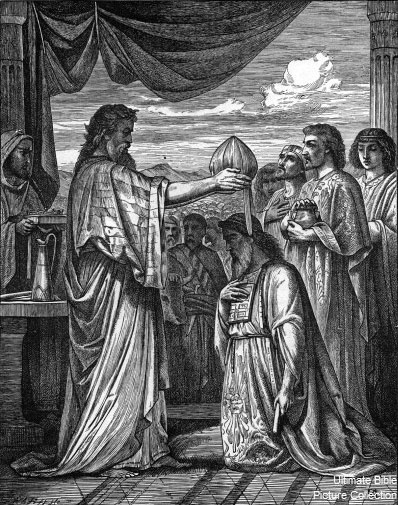
In Through New Eyes, James Jordan notes that the wilderness was Havilah, the place mentioned in Genesis 2 that was rich in raw materials. Israel stripped Egypt of her gold, then plundered the desolate places of hidden wealth. She came out of the desert with a High Priest clothed in gems, and a new generation of soldiers born of God’s threshing floor.
The manna began to fall just after the Hebrews’ victory over Pharaoh. As with Jacob, the Lord was faithful to provide for His chosen one. But perhaps, in covering the ground, there is also the idea of a firmament (this might sound strange to some readers, but I have found the concept is a frequent one). The wilderness is the place of the humble bread of priesthood, displayed in obedience to God. It was the next generation that would drink the wine of Canaan after obedience under Joshua.
A Memorial
The Lord commanded that some manna be put into the Ark as a memorial. Symbolising manna, the white stone is a memorial of faithful priesthood. Joshua’s crossing of the Jordan was memorialised by large, engraved, white stones.
Continue reading
Comments Off | tags: Ark of the Covenant, Atonement, bdellium, Cain, Crucifixion, Ezekiel, Haman, Havilah, Herod, High Priest, James Jordan, Table of Showbread, Talmud, Urim and Thummim, White stone, Zechariah | posted in Biblical Theology, The Last Days
May
20
2009
The Purpose of the Restoration Covenant
“The restoration period is the last era of Israel’s history as the people of God and the climactic period of old covenant. The kingdom of God has grown beyond Israel and spread to the nations, who are the God-appointed protectors of His priestly people. Israel’s loss of independence and submission to Gentile powers was not a backward movement in the kingdom program of God. Abraham had been chosen by God so that through him all the nations of the world could be blessed (Gen. 12:3). In the restoration era, this was fulfilled more than at any other time in Israel’s history. Through the dispersion Jews had spread all over the world and they brought with them the knowledge of the true God.
Continue reading
Comments Off | tags: Babylon, Covenant Theology, Daniel, David, Ezekiel's Temple, Nathan, Persia, Restoration, Temple | posted in Biblical Theology, Quotes, The Restoration Era
May
17
2009
Furnishing the New House
Zechariah’s night visions move God’s furniture around. As we saw, the instructions for the Tabernacle furniture align it with the Creation Week. And the Creation Week corresponds with the seven Feasts. Zechariah’s visions follow the Creation and Feast patterns, but the Tabernacle furniture has been shifted around all over the place.
Now, you will probably ask how eight visions can align with seven days or seven feasts. The answer is that it takes the two visions in chapter 5 to reflect the Day of Atonement. Thus:
Continue reading
1 comment | tags: bdellium, Lampstand, Manna, Meredith Kline, Revelation, White stone, Zechariah | posted in Biblical Theology, The Last Days