Aug
18
2009
Old Saints
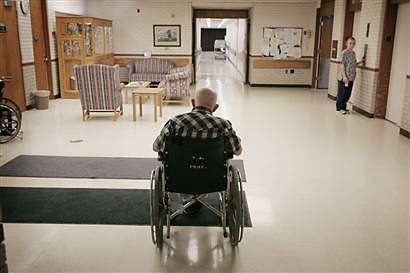
The Master loiters in nursing homes.
Waiting on those who wait for Him,
With those whose grip on life is failing,
Who can do nothing now but pray.

The Master loiters in nursing homes.
Waiting on those who wait for Him,
With those whose grip on life is failing,
Who can do nothing now but pray.
If you haven’t heard John Piper’s sermons on the importance of baptism and church membership last year, do yourself a favour.
Frank Turk does have an issue with one point, however, which I repost here with his permission:
. . . . . . . . . . . . . . . . . . . . . . . . . .
Dr. Piper opens up the can of worms at his church again by beginning a series on baptism and church membership. The long-time readers of this blog know for a fact that this topic is near to me and dear to me — because it’s one of the topics I have blogged about most often. And in that, I think I am more a Baptist for it today than I was 3 years ago.
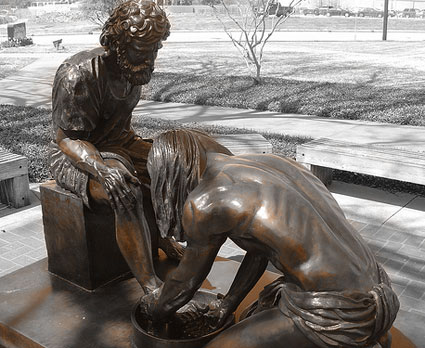
After reading about the Bible’s use of robes as symbols of office (see The Dominion Trap by James B. Jordan), Tim Mitchell commented:
In Bible study we’ve been looking at John, so a few weeks ago was John 13. My Bible translated v.4-5 as “So he got up from the table, took off his robe, wrapped a towel around his waist, and poured water into a basin. Then he began to wash the disciples’ feel, drying them with the towel he had around him.”
So that recalled for me the couple of pages on robe imagery, and it seems to foreshadow what Jesus will do later on very well: He is willing to take off his authority and righteousness, and take on the dirt of our sin.
But then I got a bit unsure, since Jesus then goes on to say “you ought to wash each others’ feet” in v.14 and “Do as I have done to you” in v.15. So if the symbolism applies, how are we also supposed to take other peoples’ sin on us as Jesus did?
Firstly, what a great question. Many New Testament passages become so familiar that we often lose the ability to really think about their ramifications.
The structure of the Last Supper puts this action of Jesus at Atonement, the Laver (Day 6). Jesus is liturgically pre-enacting His role as High Priest. The Adam removed his glorious robes and wore linen for the Day of Covering. Jesus left this in the tomb with our sin on it. But that is not all the High Priest did. He approached the Most Holy twice.

NOTE: THIS POST HAS BEEN REMIXED AND INCLUDED IN GOD’S KITCHEN.
I listened to a White Horse Inn podcast recently, titled Boredom and Entertainment.
Compared with an action-packed movie, most people would probably characterise the ministry of the word and sacrament as “boring.” So in order to reach out, should churches make their services more entertaining? Joining the panel for this discussion is Richard Winter, author of Still Bored in a Culture of Entertainment…

“…love your enemies, bless those who curse you, do good to those who hate you, and pray for those who spitefully use you and persecute you, that you may be sons of your Father in heaven; for He makes His sun rise on the evil and on the good, and sends rain on the just and on the unjust.” Matthew 5:44-45
Most “Bible contradictions” display our ignorance of literary forms, history, or customs. Further study always vindicates the Bible. Sometimes, however, the “contradiction” is just a misunderstanding of the way God works; a question of timing.
The supposed contradiction I want to discuss is this: if God punishes the wicked, how can He also send rain on the just and the unjust?
The content of this post has been revised and included in Bible Matrix II: The Covenant Key.
__________________________________
[1] Do you think I can find this when I need it?
[2] On the apostolic church as “two witnesses”, see: Slavery to Sabbath in Revelation 5-11
The devil hates confession. It breaks his power over us. He would rather have us confine ourselves behind the bars of our own private Sheols than get right with God.
Why is confession so powerful? Because it is judicial. It is an application of the knowledge of good and evil. Continue reading
“Then they came to Jesus, and saw the one who had been demon-possessed and had the legion, sitting and clothed and in his right mind. And they were afraid.” Mark 5:15
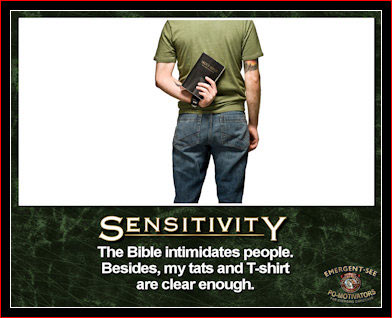
There’s a discussion about tatts and piercings going on at dougwils.com
Like Jello on a Plate and Unleashing Your Inner Fundamentalist
Here’s my 2 cents:

or Judaism is a Testimony to the End of the World
There is a patisserie in the Blue Mountains that bakes traditional German sourdoughs. Originally the mother culture for their sourdoughs was brought to Australia in a phial by the owner’s father from a bakery near Stutgart. The culture is 500 years old and has been given the name, “Corey”. This is a fantastic picture of what leaven symbolises in the Bible. It is not a symbol of sin. It is a symbol of historic continuity.
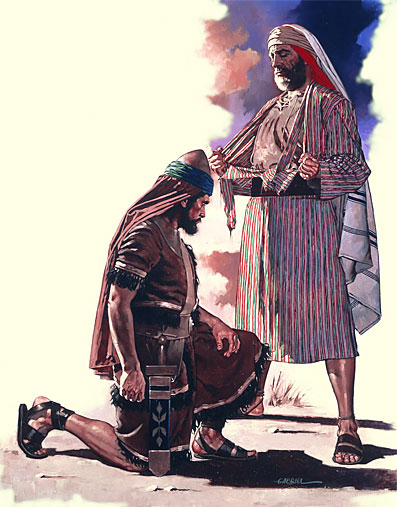
Under Rehoboam, Solomon’s kingdom became even more like Egypt. Solomon had imposed greater taxes upon his people than were appropriate, and his son Rehoboam took this to the extreme. So the Lord brought about a new Exodus, with Jeroboam as a kind of Moses. David felt guilty for cutting the corner off Saul’s robe — ie. grasping at Saul’s symbol of office — but to Jeroboam the prophet gave ten of the twelve pieces of his robe, the ten northern tribes.
from Manifesto on Psalms and Hymns
by Douglas Wilson (Introduction to the Cantus Christi Hymnal)
A common practice in our day is for Christians to speak of the “culture wars.” By this they usually mean the political and cultural skirmishes between leftist secular thinking and the more moderate and traditional thinking of believers. But the problem is that the phrase “culture wars” is a particularly inept way to refer to this problem. Continue reading

 Bible Matrix blog