Aug
26
2013
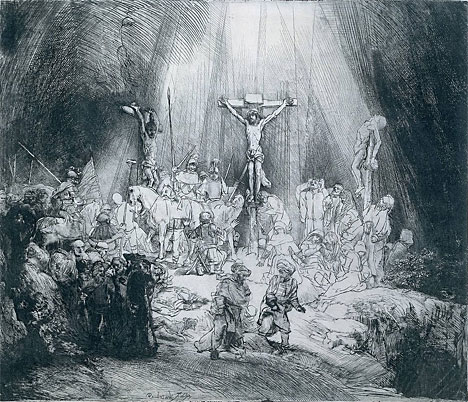
“Then I saw heaven opened, and behold, a white horse! The one sitting on it is called Faithful and True, and in righteousness he judges and makes war… From his mouth comes a sharp sword with which to strike down the nations, and he will rule them with a rod of iron.” (Revelation 19:11-15)
The Bible is big on fruit. The first “Covenant Ethic” was a prohibition on fruit from a particular tree. The transgression of Adam resulted in curses upon the fruit of the Land and the fruit of the womb. The book which describes the end of the Old Covenant, the Revelation, shows the dragon attempting to eat the son of Adam, the fruit of the womb, and then to devour the fruit of the Land, the apostolic “firstfruits” Church. [1] But where is the forbidden tree?
Continue reading
Comments Off | tags: AD70, Communion, Firstfruits, Lampstand, Revelation, Tabernacle, Temple | posted in Bible Matrix, Biblical Theology, The Last Days
Aug
13
2013
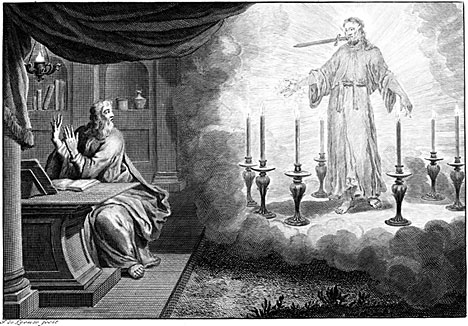
“We come as those who receive first and then, second, only in reciprocal exchange do we give back what is appropriate as grateful praise and adoration.”
The next excerpt from the condensed version of Jeff Meyers‘ The Lord’s Service. You might start to see the “head and body” Bible Matrix pattern beginning to show through here…
Continue reading
Comments Off | tags: Communion, Covenant Theology, Ecclesiology, Jeff Meyers, Worship | posted in Bible Matrix, Quotes
May
21
2013
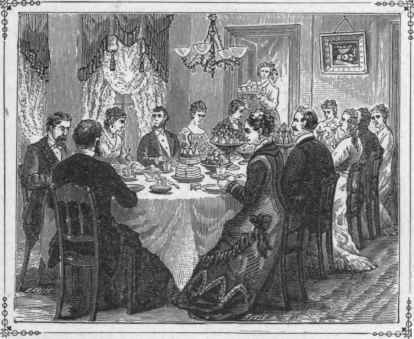
“Matthew understands Jesus to be the rightful heir of the chieftaincy who instead volunteers to become the Victim at the tribe’s feast. But by being the voluntary victim, he becomes the first victim in the world who can speak.”
An excerpt from Eugen Rosenstock-Huessy’s “Fruit of Lips”:
“…as oral as Peter the fisherman must have been and as much as he probably detested ink, Matthew certainly was familiar with paper work and written records, only too well. Since we do not expect him to be employed inside his old activities, where he had used writing for superficial purposes to say the least, we may expect him to fight elsewhere…”
Continue reading
Comments Off | tags: Communion, Eugen Rosenstock-Huessy, Gospels, Matthew, Sacraments | posted in Biblical Theology, Ethics, Quotes
May
11
2013

What is the referent of “body of Christ” in 1 Corinthians 11:29?
“For anyone who eats and drinks without discerning the body eats and drinks judgment on himself.”
Continue reading
Comments Off | tags: Baptism, Communion, Corinthians, Covenant curse, Covenant Theology, Doug Wilson, Literary Structure, Melchizedek, Numbers 5 | posted in Bible Matrix, Biblical Theology, Christian Life, Q&A
Aug
16
2012

“Now therefore fear the Lord (T)
and serve him in sincerity and in faithfulness. (H)
Put away the gods that your fathers served (E)
beyond the River and in Egypt, (O)
and serve the Lord.” (S)
Joshua 24:14
40 Years of Harlotry
Israel famously wandered in the wilderness for forty years. They were tested, offered as a sacrifice and refined with the holy fire of the Law of Moses. This “threshing” process appears at the centre of the Bible Matrix. It is pictured as the time of harvest (Pentecost – the giving of the Law), and as the burning eyes of the Lampstand watching over Israel (sun, moon and five visible planets). In the Covenant pattern it is the “Ethics,” the bit where God lays out the rules for success. Threshing is also a biblical euphemism for sexual relations. At this point, under the Lawful eyes of God, Israel is either shown to be a faithful bride or an adulteress. Is the fire of her desire true or “strange” (foreign). We can see this pattern in James 1:15. It is a sick parody of the Covenant process because it begins with a “false word.”
[This post has been refined and included in Sweet Counsel: Essays to Brighten the Eyes.]
Continue reading
Comments Off | tags: Aaron, Communion, Covenant curse, Covenant Theology, Exodus, James Jordan, John the Baptist, Joshua, Malachi, Moses, Numbers, Numbers 5, Rene Girard | posted in Apologetics, Bible Matrix, Biblical Theology, Christian Life, The Last Days
Aug
9
2012
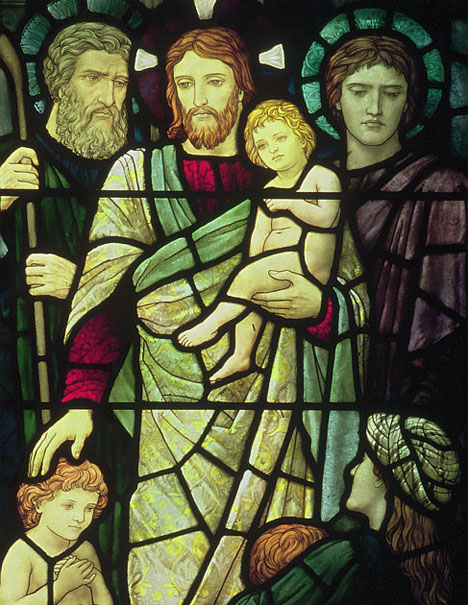
“Let the children
…..come to me,
……….and do not hinder them,
…..for to such belongs
the kingdom of God.”
(Luke 15:16)
Jesus is often pictured with a child or children. His love for children is used as evidence for infant baptism. After all, aren’t we bringing our infants to Jesus in paedobaptism and paedocommunion?
Continue reading
7 comments | tags: Baptism, Communion, Federal Vision, High Priest | posted in Bible Matrix, Biblical Theology
Jul
17
2012
“Jordan lays out all of the theological and typological issues connected to worship, and more specifically to the Lord’s Supper itself.”
Adam Ross, who I reckon gets through five books on a slow day, has reviewed James Jordan’s From Bread to Wine: Toward a More Biblical Liturgical Theology on goodreads.
Continue reading
Comments Off | tags: Adam Ross, Communion, James Jordan, Liturgy, Maturity, Worship | posted in Biblical Theology, Quotes
May
26
2012
“Roman” Catholic is a contradiction in terms. Much like “World Series” Baseball.
The “Too catholic to be Catholic” goodness continues, with Rich Bledsoe and James Jordan pitching in from different angles:
Continue reading
Comments Off | tags: Communion, Compromise, James Jordan, Peter Leithart, Reformation, Rich Bledsoe, Roman Catholicism | posted in Quotes
Apr
1
2012
Joe Rigney and Doug Wilson sit down to discuss the life, theology, and impact of Jonathan Edwards.
Continue reading
Comments Off | tags: Baptism, Church Discipline, Church History, Communion, Doug Wilson, Ecclesiology, Joe Rigney, Jonathan Edwards | posted in Christian Life
Mar
30
2012
or Not What It Says On The Tin
 “We are not baptized because of who we are but because of Whom we have believed.”
“He who loves father or mother more than Me is not worthy of Me; and he who loves son or daughter more than Me is not worthy of Me. And he who does not take his cross and follow after Me is not worthy of Me. He who has found his life will lose it, and he who has lost his life for My sake will find it.” (Matthew 10:37-39)
Time for yet another baptism rant. I thought I’d said everything I needed to say, but a recent post by Dr Leithart, whose words are usually music to my ears, was like being captive at a karaoke contest.
Continue reading
13 comments | tags: Baptism, Communion, Federal Vision, Peter Leithart | posted in Biblical Theology, Quotes