Apr
8
2009
Doug Wilson on Imputation
“Salvation is a gift. Damnation is a paycheque.”

“In those days there was no king in Israel.”
This is seen by some as a reference to the Davidic monarchy. Israel is in anarchy, and only a strong centralised state can help her. This is exactly the opposite of the message of Judges. Continue reading
“(Adoniram) Judson was a lover of the Word of God. The main legacy of his 38 years in Burma was a complete translation of the Bible into Burmese and a dictionary that all the later missionaries could use. Once when a Buddhist teacher said that he could not believe that Christ suffered the death of the cross because no king allows his son such indignity, “Judson responded, ‘Therefore you are not a disciple of Christ. A true disciple inquires not whether a fact is agreeable to his own reason, but whether it is in the book. His pride has yielded to the divine testimony. Teacher, your pride is still unbroken. Break down your pride, and yield to the word of God.’”
John Piper | How Few There Are Who Die So Hard! Suffering and Success in the Life of Adoniram Judson: The Cost of Bringing Christ to Burma
www.desiringgod.org/ResourceLibrary/Biographies
Tim Keller asked the following question to his denomination:
“How do we, as a denomination, do renewal and outreach in the emerging post-everything United States culture? ‘Post-everything’ people are those who are now in their teens and twenties—and they are our future.”
In his brief article, Keller lays out six issues at stake in engaging this group and how Reformed theology offers the resources to address these issues:
Issue: Post-everythings like narrative and story Continue reading
“It is a serious thing to live in a society of possible gods and goddesses, to remember that the dullest and most uninteresting person you can talk to may one day be a creature which, if you saw it now, you would be strongly tempted to worship, or else a horror and a corruption such as you now meet, if at all, only in a nightmare.
All day long we are, in some degree, helping each other to one or the other of these destinations. It is in the light of these overwhelming possibilities, it is with the awe and circumspection proper to them, that we should conduct all our dealings with one another, all friendships, all loves, all play, all politics. There are no ordinary people. You have never talked to a mere mortal…
Next to the Blessed Sacrament itself, your neighbour is the holiest object presented to your senses. If he is your Christian neighbour, he is holy in almost the same way, for in him also Christ vere latitat – the glorifier and the glorified, Glory Himself, is truly hidden.”
C. S. Lewis, The Weight of Glory: And Other Addresses
They sent therefore fifty men. And for three days they sought [Elijah] but did not find him. And they came back to [Elisha] while he was staying at Jericho, and he said to them, “Did I not say to you, ‘Do not go’?” (2 Kings 2:17-18)
It seems the Ark was “taken” like Enoch. If it was carried to Babylon, perhaps it was melted down with other conquered “gods” to contribute to Nebuchadnezzar’s “golden calf.” It fits the pattern if the Ark “died” on the altar of false worship “outside the city.” Continue reading
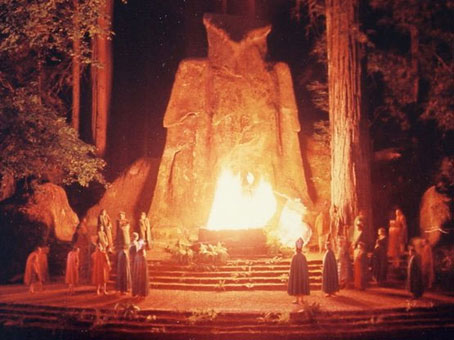 During the Creation week, there were three days of forming new “empty spaces” by dividing the original watery deep (the Abyss), then three days of filling them. A ‘world model’ develops with God’s throne at the top and the Abyss at the bottom, the place furthest from the throne. The architecture of the Tabernacle follows this model, laid out upon the ground.
When the priesthood – the Land-mediators – disobeyed God, the Abyss was dredged up to cover the Land (holy place). We see this first in the flood, and later in the invasions of Assyria, Babylon and Rome.
The Valley of Hinnom became a symbol of the ‘Abyss’ below the true mountain of God. As an evil twin of the holy place, it was an ‘Adamic’ clay pit with no glorious metal. It was also the place where Judah sacrificed their infants to false gods. It was counterfeit worship in the tabernacle of hell, and the Lord said He would fill it with their bodies. Their dark ‘table of showbread’ became a snare. [Read Jeremiah 19]
After the Babylonian captivity, Zechariah saw the church in “the deep” (often translated valley or glen). A new Land-altar was rising out of the ‘waters’ – a new mountain of God, with a new Eden-temple to mediate for the world.
TAOTA
In the Sermon on the Mount, Jesus gave the pattern for a new Tabernacle. The sermon follows the pattern of the Tabernacle furniture, which in turn follows the pattern of the Creation week.1 At ‘Day 3′, Altar and Table, are His commands concerning Covenants (divorce and oaths), and the Lord’s prayer.
“Leave your gift there before the altar, and go your way. First be reconciled to your brother, and then come and offer your gift.” Matthew 5:24
Interestingly, these blessings are mirrored by the curses upon the saints’ evil twins in Matthew 23, the Jews who sat in Moses’ seat of judgment.2 The “woes” follow exactly the same pattern, and climax with Christ’s prophecy of the destruction of the Old Covenant Temple. And what do we find in this passage at Day 3?
And the fifth angel blew his trumpet, and I saw a star fallen from heaven to earth, and he was given the key to the shaft of the Abyss. He opened the shaft of the Abyss, and from the shaft rose smoke like the smoke of a great furnace, and the sun and the air were darkened with the smoke from the shaft. Revelation 9:1-2
The fifth trumpet aligns with both the Feast of Trumpets, and Deuteronomy. It is the summoning of armies on Day 5, swarms of birds and fish filling sky and sea as glorious clouds. The Altar of the Abyss, in this case, is now an evil twin of the Altar of Incense, a demonic response to the ascension of Christ and His new government. Continue reading
“And another angel came out from the altar, the angel who has authority over the fire, and he called with a loud voice to the one who had the sharp sickle, “Put in your sickle and gather the clusters from the vine of the Land, for its grapes are ripe.” So the angel swung his sickle across the Land and gathered the grape harvest of the Land and threw it into the great winepress of the wrath of God. And the winepress was trodden outside the city, and blood flowed from the winepress, as high as a horse’s bridle, for 1,600 stadia.” Revelation 14:18-20
Like Pharaoh, the “plagues” Trumpet warnings only hardened the hearts of the Jewish leaders. Like Pharaoh, he had raised up the Herods only to demonstrate His power in their destruction (Romans 9:17). Continue reading
 Bible Matrix blog