Apr
28
2009
or How Modern Conservative Theologians Unwittingly Use Literary Genres to Mask Their Unbelief
One of the big problems with modern theology is its habit of categorising parts of the Bible into literary genres. For sure, the Bible contains historical prose, visions, poetry and songs. But many passages won’t actually fit into these neat little pigeon holes without hamstringing their intended purpose. And as it turns out, these “genre-lisations” are excuses to compromise with humanistic pop-philosophy and pop-history.
The three main gripes I have are misuses of the genres poetry, polemic and apocalyptic.
Continue reading
1 comment | tags: Apocalyptic, Daniel, David Field, Esther, Ezekiel, Gnosticism, Ideology, James Jordan, John Dickson, Peter Leithart, Restoration, Revelation, Rowan Williams | posted in Biblical Theology, Creation, The Last Days, The Restoration Era
Apr
24
2009
“Now if anyone builds on this foundation with gold, silver, precious stones, wood, hay, straw, each one’s work will become clear; for the Day will declare it, because it will be revealed by fire; and the fire will test each one’s work, of what sort it is. If anyone’s work which he has built on it endures, he will receive a reward. If anyone’s work is burned, he will suffer loss; but he himself will be saved, yet so as through fire. Do you not know that you are the temple of God and that the Spirit of God dwells in you? If anyone defiles the temple of God, God will destroy him. For the temple of God is holy, which temple you are.” (1 Cor. 3:12-17)
Are the gold, silver and precious stones our heavenly bling? From the structure of this passage, I think what Paul is referring to is the church. If we are building disciples who remain despite trials and testing from God, we will be rewarded. The immediate context of this is the false doctrine of Judaisers, and their house of gold, silver and precious stones (Herod’s Temple and his puppet High Priest’s robes). While Paul was building a Temple out of people, Herod was busy polishing the brass on the Titanic that he knew Jesus had said would be submerged under a Gentile flood (Daniel 9:26). Herod’s precious stones didn’t make it through God’s judgment. The Day declared what it was in truth.
The question is, are our disciples a robe/house for Jesus, or are they kindling in His nostrils? When He comes to judge, what will our ministry be revealed as?
Comments Off | tags: AD70, Daniel, Herod, High Priest, Holy Spirit, Judaisers, Paul, Temple, The flood | posted in Biblical Theology, The Last Days
Apr
16
2009
“Because of Christ we are thought of as fools, but Christ has made you wise. We are weak and hated, but you are powerful and respected. Even today we go hungry and thirsty and don’t have anything to wear except rags. We are mistreated and don’t have a place to live. We work hard with our own hands, and when people abuse us, we wish them well. When we suffer, we are patient. When someone curses us, we answer with kind words. Until now we are thought of as nothing more than the trash and garbage of this world.” 1 Corinthians 4:10-13
So, are God’s people to wear rags? Or should they be dressed well like Solomon or the woman in Proverbs 31? Or is that even the right question?
Continue reading
Comments Off | tags: Adam, Corinthians, Daniel, Ecclesiology, Ezekiel, Ezra, Joseph, Maturity, Mordecai, Nehemiah, Noah, Paul, Proverbs, Robes, Solomon | posted in Biblical Theology, Totus Christus
Apr
15
2009
“We shall be gods”
 “Therefore, if you died with Christ from the basic principles of the world, why, as though living in the world, do you subject yourselves to regulations — “Do not touch, do not taste, do not handle,” which all concern things which perish with the using — according to the commandments and doctrines of men? These things indeed have an appearance of wisdom in self-imposed religion, false humility, and neglect of the body, but are of no value against the indulgence of the flesh.” Colossians 2:20-23
As with nearly everthing in the Bible, the roots of this go back to early Genesis.
Continue reading
1 comment | tags: Adam, Bible history, Daniel, Esther, Food laws, Genesis | posted in Biblical Theology
Apr
11
2009
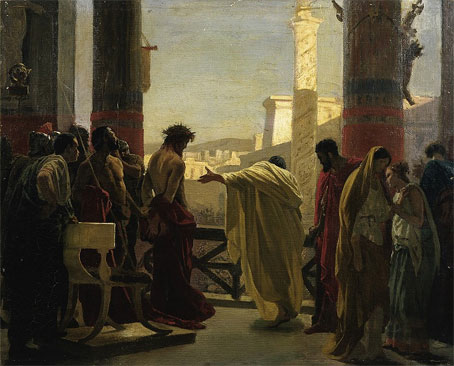
The Jews choose a violent, thieving murderer—like Herod—a beast, for release instead of the Son of God. When forced to choose, they publicly proclaim Caesar (Daniel’s fourth beast) as their king. When Adam is unjust, Eve follows the “light” of a beast.
Like Joseph and Daniel, the obedience of the suffering servant brings a nightmare to the Gentile ruler, or in this case, his wife. She warns Pilate to have nothing to do with “that just man”. From the seat of judgment, he gives the Jews a choice. Like Joseph and Daniel, the Jews unwittingly open the mystery of God.
Jesus is crowned with thorns as Adam’s successor. As Israel, He is a cursed Land bearing a cursed crop—the crown of Abimelech, the bramble king who slays his brothers. Christ dies on behalf of Herod’s kingdom, a compromised rule whose only use was kindling in God’s nostrils.
As High Priest making atonement on the mountain of God, Jesus is again flanked by two men. One ascends to paradise. The other goes to destruction.
Comments Off | tags: Abimelech, Atonement, Crucifixion, Daniel, Joseph, Judges, Pilate, Typology | posted in Biblical Theology
Apr
11
2009
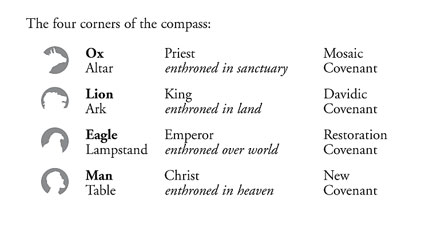
It was always God’s plan that Israel have a human king:
“When you come to the land which the LORD your God is giving you, and possess it and dwell in it, and say, ‘I will set a king over me like all the nations that are around me,’ you shall surely set a king over you whom the LORD your God chooses; one from among your brethren you shall set as king over you; you may not set a foreigner over you, who is not your brother.” Deut. 17:14-15
Like Adam, this dominion would only come by obedience: by servanthood to God and faithful mediatory witness to the Gentiles. But like Adam, they seized dominion and demanded “a king like the Gentiles.” With Saul, they had a king who palled around with Agag of Amalek whom Moses commanded to wipe from the face of the earth.
Continue reading
Comments Off | tags: Abimelech, Amalek, Babylon, Covenant Theology, Daniel, Exile, James Jordan, Malachi, Mordecai, Temple, Zechariah | posted in Biblical Theology, The Restoration Era
Apr
10
2009
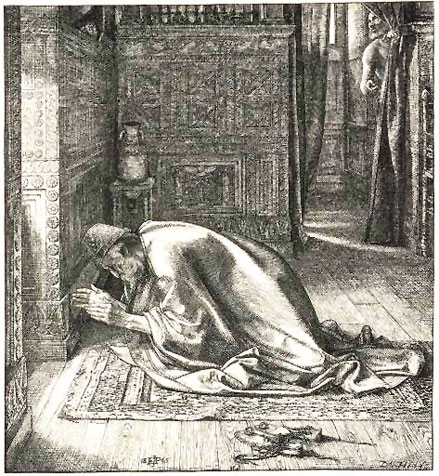
A new Adam (High Priest) ruled the wild animals of the Gentile kingdoms, but without a king this rule would be truly priestly. Daniel prefigured the nature of this new kingdom: obedience would bring persecution, and suffering as witnesses before the Gentiles would be the means of Gentile conversion. A new Israel would be the initial fulfilment of the despised, suffering priestly servant of Isaiah 53. When the Lord scattered His people for their sin, He also spread them to the four winds as witnesses to the empire.
Continue reading
Comments Off | tags: Daniel, Esther, Greek philosophy, Isaiah, Mordecai, oikoumene, Peter Leithart, Power of the Gospel, Typology, Witness | posted in Biblical Theology, The Last Days, The Restoration Era
Apr
10
2009
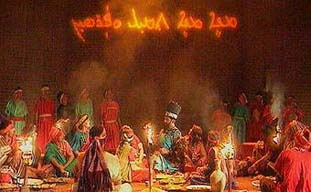
Belshazzar curses the day he let the Chaldeans talk him into signing up with Facebreadbook.
“In the same hour the fingers of a man’s hand appeared and wrote opposite the lampstand on the plaster of the wall of the king’s palace; and the king saw the part of the hand that wrote.” Daniel 5:5
“The fact that the Watcher Lampstand oversees the Facebread in the Temple means that Israel undergoes a continual inspection of jealousy. God watches all the time. In Daniel 5, the Lampstand “arrives” and sees Belshazzar’s face, “facebread” because it is at his great “bread”, and his face is undone as his “splendours change”. It is precisely as Belshazzar is drinking the wine that the judgment appears, as in the case of the woman in Numbers 5. As a priestly agent is involved in bringing judgment in Numbers 5, so Daniel is involved in bringing judgment in Daniel 5. As the woman’s loins are undone, so are Belshazzar’s. The woman’s judgment is barrenness; in the case of Belshazzar the king, the judgment is the same: no future.”1
Notice the “Holy Place” configuration. The Lampstand, the Table, and the graven Word (Ark). Daniel is the Incense Altar, the accepted elder. Why do pictures of this event never include the Lampstand? It is crucial.
_____
1 James B. Jordan, The Handwriting on the Wall, p. 289.
See also Jesus at Belshazzar’s Feast: An Explanatory Disquisition on an Aspect of the Story of the Woman Taken in Adultery for an interesting read.
Comments Off | tags: Babylon, Belshazzar, Daniel, James Jordan, Lampstand | posted in The Restoration Era
Apr
10
2009
There is a lot of truth in theonomy. But things have changed since the time of Moses. At that point, the church and state were basically one.
After the exile, things were different. The role of the Jews was to be priests within the Gentile state. They no longer had the right to administer capital punishment. When they witnessed faithfully, there was a Jew at the emperor’s right hand, steering the empire for God’s people and their stand for the truth.
By the time of Christ, instead of a Joseph, Daniel or Mordecai, the Jews had a Haman, a Herod. Instead of being a nation of priests, they wanted a king like the Gentiles. This makes Herod even more culpable for his role in the death of Christ, standing (legally) at the right hand of the power.
I believe the church today is exactly the same. The church administers ‘inhouse’ justice through excommunication. When the church is faithful in disciplining itself, and thus witnesses faithfully, it stands side by side with the state in administering capital punishment. Our failure to witness has led to ‘life’ for murderers and death for the innocent.
The Bible is clear on the shedding of innocent blood. A murderer dies to atone for the blood he shed. It is judicial. Correlating capital punishment with abortion is a total misunderstanding of justice.
As in AD70, perhaps all the innocent blood shed in this gospel age will be atoned for by the final generation. The murderers are marked like Cain for now, but Abel’s blood will be atoned for.
Comments Off | tags: Abel, AD70, Atonement, Daniel, Haman, Herod, Joseph, Mordecai, Moses, Theonomy | posted in Ethics
Apr
10
2009
Counterfeit Kingdom Come
Then the dragon became furious with the woman and went off to make war on the rest of her offspring, on those who keep the commandments of God and hold to the testimony of Jesus. And he stood on the sand of the Sea. Revelation 12:17 [ESV]
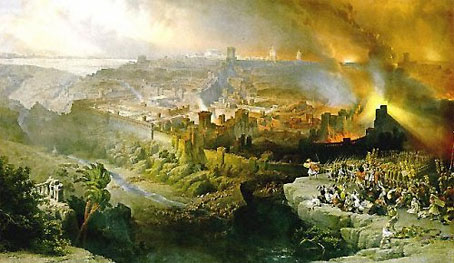
“After a number of years of peace for the Church (Acts 9:31), Wormwood poured out his poisonous waters, false Judaising doctrines, to try and corrupt the woman. God raised up Paul to defeat Satan and the Judaisers, and meanwhile the land (the Circumcision) drank up his false doctrine. Satan has engaged in two tactics: persecution and corruption. These have failed. So now he decides to return to persecution, but this time against the non-Jewish believers, the “rest of her offspring”. He stands on the sands of the sea, addressing the Roman Gentile sea, and raises up the Sea Beast.”1
Continue reading
Comments Off | tags: Amalek, Compromise, Daniel, Haman, James Jordan, Nebuchadnezzar, Paul, Revelation, Satan, Totus Christus | posted in Against Hyperpreterism, Biblical Theology, The Last Days, Totus Christus