Mar
28
2012
 “When Jesus stood at the door and knocked, He was the Covenant sheriff knocking on the Covenant door through His Covenant prophets to serve Covenant papers on the Covenant-breakers.”
A friend’s colleague recently posted a summary of wrong ways that evangelicals read the Bible, based on a chapter in Graeme Goldsworthy’s book, Gospel-Centred Hermeneutics. [1]
Boiled down even further, the main errors are:
- The “me-centred” approach: Context is meaningless. Texts speak directly to me.
- Literalism: Fulfilment in Jesus is ignored.
- Legalism: We rail about keeping the Sabbath but eat prawns.
- Subjectivisim: My reading of a passage is right because I felt a peace from God.
- Pluralism: The Bible has many possible interpretations.
- Pragmatism: There are more people at church, so what we are doing must be right, regardless of what the Bible says.
This is a good list, but simply dividing the Bible into pre-gospel and gospel leads to a misinterpretation of much biblical prophecy. Mr Goldsworthy’s blanket-style “everything is fulfilled in Jesus” hermeneutic means he himself ends up with a “me-centred” approach to the Bible.
Continue reading
Comments Off | tags: Covenant curse, Covenant Theology, Evangelicalism, Graeme Goldsworthy, Hermeneutics, James Jordan, Revelation | posted in Biblical Theology, Quotes, The Last Days, The Restoration Era
Mar
21
2012
 Following a masterful and beautiful explanation of Israel’s priestly glory, Alastair Roberts writes:
In 1 Corinthians 11:7 we encounter a verse that many might find perplexing.
For a man indeed ought not to cover his head, since he is the image and glory of God; but woman is the glory of man.
I believe that careful attention to the logic of this verse is absolutely crucial to unlocking the puzzle of the difference between the female helper apostle, and the male helper apostle.
Continue reading
Comments Off | tags: Alastair Roberts, Corinthians, Ecclesiology, Genesis, N. T. Wright | posted in Biblical Theology, Creation, Quotes
Mar
19
2012
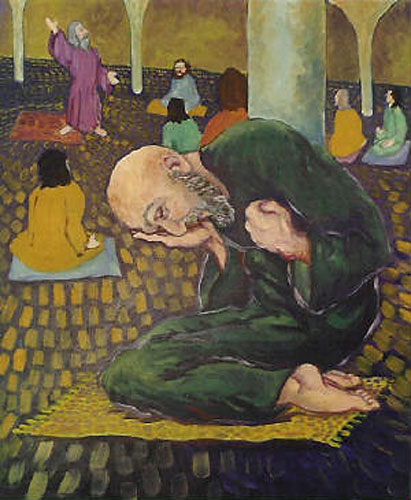
“The abundant life is a life that is constantly being beheaded by the truth.”
Legalism and Leadership
“For I say to you, that unless your righteousness exceeds the righteousness of the scribes and Pharisees, you will by no means enter the kingdom of heaven.” (Matthew 5:20)
You may have had some experience with a “legalistic” church or Christian. We all know that a domineering leadership is a curse to the work of God, but so many people who make the decision to leave such ministries, or individuals, behind become “lawless” in their liberty. What’s really going on there, and what is the Bible’s solution for legalism?
[This post has been refined and included in Sweet Counsel: Essays to Brighten the Eyes.]
Continue reading
1 comment | tags: Doug Wilson, Genesis, Holiness, Pharisees | posted in Biblical Theology, Christian Life
Mar
17
2012
Comments Off | posted in Biblical Theology
Mar
16
2012
 Douglas Wilson writes:
“What is the meaning of ”one is taken and the other left’? This is commonly thought to refer to the rapture — one taken up into heaven, and the other left on earth to kick himself for not praying the sinner’s prayer when he had a chance. On the bright side, there will be a lot of free, unmanned cars available” (Heaven Misplaced, p. 104).
Matthew 24 is a prediction of the Covenant curses falling upon Judah for the last time. One being taken and the other left has to do with displacement. Titus enslaved the best Jews and took them in ships to Egypt.
“And the Lord will take you back to Egypt in ships, by the way of which I said to you, ‘You shall never see it again.’ And there you shall be offered for sale to your enemies as male and female slaves, but no one will buy you.” (Deuteronomy 28:68)
It’s one thing to get the historical fulfilment correct, but there’s a whole lot more going on here. In His speech, as the fulfilment of Israel, Jesus is working through the Bible Matrix, a combination of the Creation week, the weekly and annual Feasts, and the process of Dominion. This means that He is using examples of all the previous historical Covenant structures to make His point. The Covenant cycle has snowballed through history and picked up a lot of events on its way.
Continue reading
1 comment | tags: Abel, Atonement, Cain, Covenant Theology, Deuteronomy, Doug Wilson, Esau, Feasts, Genesis, Jacob, Lamech, Literary Structure, Matthew, Systematic typology | posted in Against Hyperpreterism, Bible Matrix, Biblical Theology, The Last Days
Mar
10
2012
or The Federal Vision Isn’t Big Enough

But Jesus knew their thoughts, and said to them: “Every kingdom divided against itself is brought to desolation, and every city or house divided against itself will not stand. If Satan casts out Satan, he is divided against himself. How then will his kingdom stand?” (Matthew 12:25)
ACT I – An End to Sacrifice
“In AD70, the ‘office’ of Jew was finished forever (there are no more Jews in God’s eyes) and the “office” of Gentile was also finished. The middle wall was broken down. Any distinctions now are merely human distinctions.”
Continue reading
4 comments | tags: Baptism, Church History, Constantine, David P. Goldman, James Jordan, Lamech, Noah, oikoumene, Peter Leithart, Politics, Postmillennialism, Revelation, Rom | posted in Biblical Theology, Quotes, The Last Days, The Restoration Era
Mar
7
2012
or Will Jesus Spit Us Out?
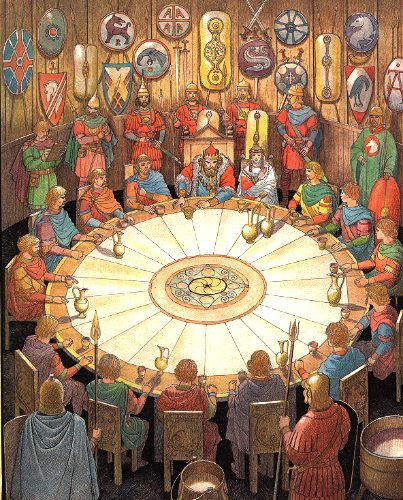
“But let a man examine himself, and so let him eat of the bread and drink of the cup. For he who eats and drinks in an unworthy manner eats and drinks judgment to himself, not discerning the Lord’s body. For this reason many are weak and sick among you, and many sleep.” (1 Cor. 11:28-30)
Some more detailed thoughts on what God is doing in the Lord’s Table. Part 1 here.
Covenant Renewal Worship follows the Bible Matrix. This means that our Christian worship recapitulates the Creation Week, the Feasts of Israel, and the journey from slavery to Sabbath (servants to sons), and the process of maturity, from childhood to adulthood. [1]
Continue reading
Comments Off | tags: Baptism, Communion, Corinthians, Covenant Theology, Federal Vision, Hebrews, James Jordan, Judas, Worship | posted in Biblical Theology, Christian Life, The Last Days
Mar
6
2012
…Your Instructors Pray You Won’t Ask
A great little book in the Gary North arsenal.
Here’s the thought-provoking questions. Download the book for his thought-provoking answers (1oMB PDF).
Continue reading
1 comment | tags: Gary North | posted in Biblical Theology, Ethics
Mar
5
2012
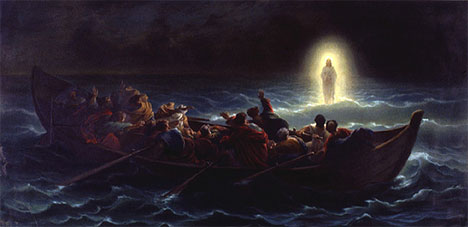
“…and they saw the God of Israel. And there was under His feet as it were a paved work of sapphire stone, and it was like the very heavens in its clarity. But on the nobles of the children of Israel He did not lay His hand.” (Exodus 24:10-11)
Well, I’ve been blustering on about art and “intuition” in generalities for about a week now. Fluffy generalities are exactly the kind of thing that annoys me about many Biblical scholars, and I reckon it annoys God, too. They never seem to get down to specifics, and He is very specific. This shows in His architecture, and also in His literary architecture. So, here, in a section of Matthew 14, is a chance for me to get specific and show you what is possible with this “killer hermeneutic.” [1]
After a brief look at the structure of this passage the other day, I thought I’d spend some more time on it. A closer analysis has revealed an even greater beauty than I expected. (I have briefly referenced the order of words in the Greek to avoid any great missteps, so it may not be perfect, but it’s close.) Much learning hath indeed made me mad but I hope you’ll take a few minutes to see this passage through my eyes.
Continue reading
Comments Off | tags: Atonement, Booths, Covenant curse, Covenant Theology, Feasts, High Priest, Laver, Literary Structure, Matthew, Moses, Tabernacle, Ten Commandments | posted in Against Hyperpreterism, Bible Matrix, Biblical Theology, The Last Days
Mar
3
2012

“The Trinity is certainly a mystery, but it only remains a mystery to us because we don’t take the Bible’s detailed architectural descriptions seriously.”
in·ef·fa·ble/inˈefəbəl/
Adjective: Too great or extreme to be expressed or described in words.
We’ve been discussing the “intuition” required to makes sense of the Scriptures. Why is this the case? Are words somehow more than words? How is it that we can make more “sense” of sentences than what they obviously contain to the naked eye?
The idea of “reading between the lines” makes Bible scholars rightly nervous. Coming up with “new stuff” from ancient texts can most certainly be a dangerous pastime. But there are guidelines, and they have to do with relationship.
Continue reading
Comments Off | tags: Hermeneutics, Peter Leithart | posted in Bible Matrix, Biblical Theology