Jun
27
2009
or Silencing the Higher Critics

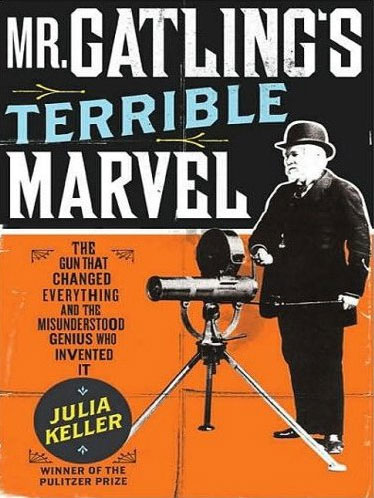
Yet more on literary analysis of the Bible as a ‘terrible marvel‘; a review of two books. As Warren Gage has commented, we are on the verge of a tremendously creative time in Biblical theology. But this to me seems also to be an element of scholarship returning home, older and wiser, from a wilderness of unbelief.
Genesis: The Story We Haven’t Heard
by Paul Borgman. Downers Grove, IL: Intervarsity Press, 2001. 252 pages.
The Literary Structure of the Old Testament: A Commentary on Genesis-Malachi
by David A. Dorsey. Grand Rapids, MI: Baker Books, 1999. 330 pages.
Reviewed by Timothy Paul Erdel, Ph.D., Archivist and Assistant Professor of Religion and Philosophy, Bethel College, Mishawaka, IN.
“I have been fascinated by the primal power of Old Testament stories for as long as I can remember. From my perspective, there is no clearer window on human character, no greater storehouse of hard and holy truths. Yet some tales are deeply disturbing. Phyllis Trible calls them ‘texts of terror.’ Even the most familiar passages may seem strangely distant. So I relish each time a preacher or teacher sheds new light on these ancient Hebrew narratives.
Continue reading
Comments Off | tags: Abraham, Babel, C. S. Lewis, Chiasm, Compromise, David A. Dorsey, Higher Criticism, Isaiah, Jeremiah, Literary Structure, Warren Gage | posted in Biblical Theology, Quotes
Jun
25
2009
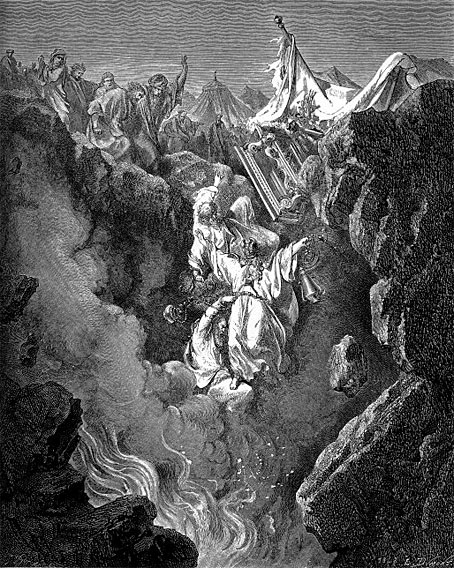 “Let no one deceive you by any means; for that Day will not come unless the falling away comes first, and the man of sin is revealed, the son of perdition.” (2 Thessalonians 2:3)
Non-dispensationalists are often accused of “Replacement Theology,” that is, the church replaced Israel. But we find in the Old Testament many examples of the same process prefiguring what the people of God went through in the first century. It is not replacement, but transformation.
Continue reading
Comments Off | tags: Aaron, AD70, Caleb, Ezra, James Jordan, Judaisers, Korah, Moses | posted in Biblical Theology, Quotes, The Last Days
Jun
23
2009
The serpent poured water like a river out of his mouth after the woman, to sweep her away with a flood. But the [Land] came to the help of the woman, and the [Land] opened its mouth and swallowed the river that the dragon had poured from his mouth. (Revelation 12:15-17)
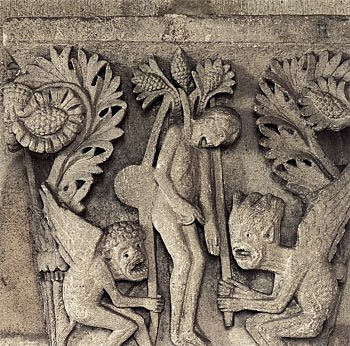 Satan mimicked the expanding gospel dominion with counterfeits at every step. Here, not only did he forge the water chariots of the true Temple (a false baptism), he would bring Noahic “rest” to the Land by destroying God’s mighty men. He would bring about his own twisted “new earth” by deluging the church with bogus teaching.
Continue reading
Comments Off | tags: AD70, Esau, Herod, Judas, Korah, Numbers 5, Satan, Scavengers, Temple | posted in Biblical Theology, The Last Days, Totus Christus
Jun
22
2009
 “…the crisis of fatherhood, in its many forms, is at the root of most disorders in this late stage of Western civilization. And the root is intimately connected to the loss of our consciousness of the hierarchical nature of the created order. Large numbers of people not only seem unable to believe in God, but also cannot conceptualize Him in their thoughts and their hearts. The icon in the heart—the icon of fatherhood—is either damaged or absent entirely. Continue reading
Comments Off | tags: Culture, Fatherhood, Michael O'Brien | posted in Biblical Theology, Christian Life, Quotes
Jun
20
2009
 or Systematic and Biblical Theologies
More on typology. A helpful picture.
Tim Challies summarises Gage and Barber’s approach in their study guide on Genesis 37-50:
“I have learned to expect to be underwhelmed with study guides. Sadly, it was with this expectation that I began to read The Story of Joseph and Judah, a guide written by Warren Gage, Associate Professor of Old Testament at Knox Theological Seminary and Christopher Barber, a lawyer who is also a graduate of Knox Theological Seminary. I am glad to say that this guide, which promises to provide a ‘fresh look at Genesis 37-50,’ does just that and does it very well.
Continue reading
Comments Off | tags: Joseph, Judah, Tim Challies, Typology, Warren Gage | posted in Biblical Theology, Quotes
Jun
20
2009
or Typology: Deadly Weapon or game of Scattergories?
“Chiastic literary analysis has completely destroyed liberal literary criticism. Liberalism is in tatters, bleeding and dying. Liberalism cannot survive Dorsey’s chiastic proof of the total unity of Isaiah, for instance. Dorsey finds loads of 7-fold chiasms in the Bible. I’ve found scores more, quite independently. What Dorsey does not see is that these are recaps of the chiasm of the 7 days in Genesis 1. And that’s good, because it means he did not go through the Bible forcing passages into heptamerous chiasms. He just found them there, and others can see that these track Genesis 1 as ‘new creation’ passages.”
—James B. Jordan, A Reply on the Nature of the Psalter, Biblical Horizons blog, biblicalhorizons.wordpress.com, referring to David A. Dorsey, The Literary Structure of the Old Testament.
If chiastic literary analysis (along with typology as I posted recently) is such a powerful weapon against a modernist interpretation of the Bible, why are these methods of study shunned by those who oppose liberal theology? Why are theologians hauled over the coals for using it if it leaves the enemy in shreds?
Continue reading
4 comments | tags: David A. Dorsey, David Field, Liberal theology, Peter Leithart, Systematic typology, Typology, Warren Gage | posted in Apologetics, Biblical Theology, Totus Christus
Jun
16
2009
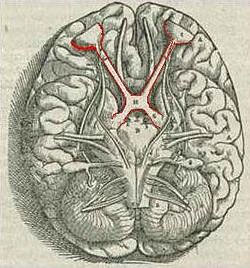
This is the intro to one JBA’s Amazon booklist. Too good a quote to pass up:
“In recent years postliberal theology and certain strands of Reformed thought have seen typology and chiasm as an essential method of biblical study.
While some forms of postmodernity are helpful to the church, most are not as avant garde as they pretend.
Ironically, liberals and most conservatives have the same method of bible study: you the individual must learn as many facts about the text as possible, importing back into the text foreign paradigms (or more accurately, bad foreign paradigms).
Typology, however, provides a subtle but deadly maneuver against modernity: it challenges modernity’s use of reason and forces it to think in terms of story and symbol, which by definition it can’t do.”
Yes, conservatives, he means you.
(Pic: the optic chiasma)
Comments Off | tags: Chiasm, Modernism, Typology | posted in Biblical Theology, Quotes
Jun
15
2009
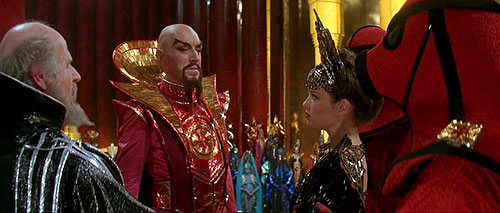
One major difference between Jordan and other preterists is his identification of Paul’s “man of sin.” Jordan is correct in naming the Herods rather than Nero because he understands biblical typology better.
Continue reading
2 comments | tags: Belshazzar, cherubim, Daniel, Esther, Film, Herod, James, James Jordan, Joseph, Mordecai, Nero | posted in Biblical Theology, The Last Days, The Restoration Era
Jun
14
2009
A brilliant thought (I think) from shotgun over at the AV forum:
I’m currently reading Gary North’s commentary on Genesis, “The Dominion Covenant.” It is probably one of the most enlightening books I’ve ever read, especially in terms of economics.
Anyway, I ran across some ideas that might serve to savage any and all attempts to intertwine the Genesis account with modern theories of evolution. (Gary North doesn’t apply these conclusions in this way. This speculation is all Shotgun.)
Gary North says this:
Under covenantal dominion, cursed nature’s restraints are progressively lifted. (Pg. 84)
He claims earlier that the “Earth was never designed to be autonomous.”
It seems to me that those who would posit long periods of time before man arose (as man) are implying that the Earth (and nature without man) has some sort of autonomous purpose apart from man. Implicit then, in systems like those of Hugh Ross, is the assumption of an autonomous sphere of sovereignty allocated to nature.
This cannot be true since there is no neutrality. In seeking to critique theistic evolutionary models, then, we should be on the lookout for any implications of an autonomous wilderness.
6 comments | tags: Compromise, Dominion Theology, Economics, Gary North, Hugh Ross, Theistic Evolution | posted in Biblical Theology, Creation
Jun
12
2009

Isaiah’s visions of Israel’s restoration have nothing to do with a future millennial golden age for the Jews, or even directly with the first century, except by the events of the Restoration era prefiguring later history. His words were for his hearers, for both their condemnation and their hope in the near future. Why do we get him wrong?
Continue reading
3 comments | tags: David, Isaiah, Millennium, Mordecai, Noah, Restoration, The flood, Zerubbabel | posted in Biblical Theology, The Last Days, The Restoration Era, Totus Christus