Jan
13
2010
“Peter came to Him and said, ‘Lord, how often shall my brother sin against me, and I forgive him? Up to seven times?’ Jesus said to him, ‘I do not say to you, up to seven times, but up to seventy times seven.’” (Matthew 18:21-22)
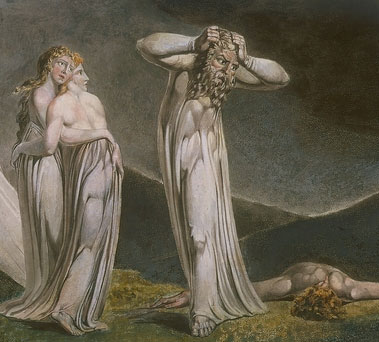
Genesis 4 seems to contain two “feast” cycles. Near the end of the first, at “Atonement”, the Lord set a mark upon Cain to protect him from vengeance. As on the Day of Covering after Adam’s sin in Eden, the full weight of the law was withheld. Cain complained that his “liability” was greater than he could bear. Cain was covered but he still went from the presence of the Lord, as the goat which carried the sins into the wilderness. It seems Cain despised mercy.
Just as the Lord and the Land were two witnesses against his crime, he now fled from the face of the Lord and the face of the Land. Only the High Priest could face God, standing in the Veil, the firmament between heaven and earth. Abel was the true facebread, the authorised priest. [1]
Continue reading
6 comments | tags: Abel, Abraham, AD70, Atonement, Azal, Cain, Esau, Genesis, Herod, Jacob, Lamech, The flood | posted in Biblical Theology, The Last Days
Jan
12
2010
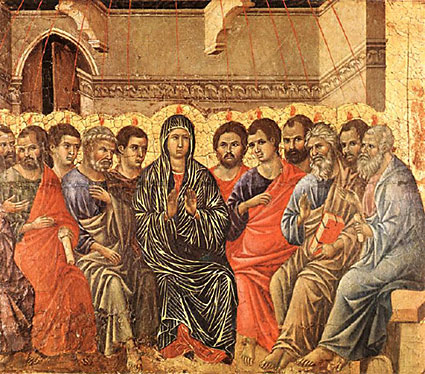
“I indeed baptize you with water unto repentance, but He who is coming after me is mightier than I, whose sandals I am not worthy to carry. He will baptize you with the Holy Spirit and fire.” Matthew 3:11
I remember a scene from X Files where they printed out a binary code and laid the pages out on the floor. When viewed from a distance the ones and zeros made the image of a face. There was a similar scene in one of the Indiana Jones movies, where there was a search for a secret passage and it turned out to be a large X on the floor when viewed from above. This is just my view, but it seems a lot of theologians spend a great deal of time walking in circles in the jungle, lost in the details of prooftexts when we have Old Testament “Google maps” at our fingertips.
Continue reading
2 comments | tags: Baptism, Bible Matrix, Film, John the Baptist, Pentecost, Tabernacle, Tongues | posted in Biblical Theology, The Last Days
Jan
10
2010

or Being a Truly Impure Thinker
“If you love me, you will keep my commandments.” John 14:15
NOTE: THIS POST HAS BEEN REMIXED AND INCLUDED IN GOD’S KITCHEN.
You must be logged in to see the rest of this post.
Join now for a year for $15!
Peter Leithart wrote this week:
How do we know things? Experimentation, deduction, observation?
In Genesis, knowledge is first associated with two things – with food and with sex. There is a tree of the knowledge of good and evil, whose fruit opens the eyes of Adam and Eve so that they perceive that they are naked. Then Adam knows his wife and she conceives Cain.
If we want a strictly biblical answer: Knowledge is eating. Knowledge is sex.
Continue reading
Comments Off | tags: Add new tag, Communion, Eugen Rosenstock-Huessy, Food laws, Maturity, Moses, Peter Leithart, Solomon, Wisdom | posted in Biblical Theology, Christian Life
Jan
8
2010
[Link to parts 1 and 2.]
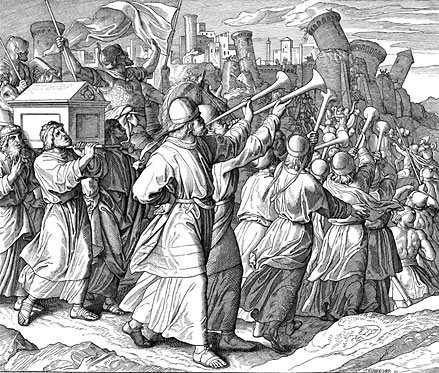
In Revelation 4-5, Jesus ascends and opens the New Covenant scroll (Firstfruits). As Moses, He then opens the Law to Israel (Pentecost). These open seals lead into the partial judgments of the Trumpets. They summon a new generation of Israel and warn the old. The last trumpet, as in Joshua, is itself “seven thunders” (John’s “Little Book”) that bring total destruction to the defiant city, in this case, Herod’s Babylon (Atonement). This is the last trumpet Paul referred to.[1]
Continue reading
Comments Off | tags: Elijah, Feasts, James Jordan, Moses, Peter Leithart, Revelation | posted in Biblical Theology, The Last Days
Jan
7
2010
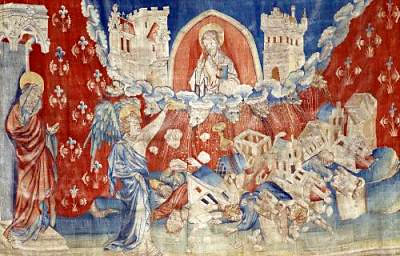
Revelation can’t be fully appreciated without attention to its literary structure. I’m no expert, but have a gander at this…
Continue reading
4 comments | tags: AD70, Atonement, David Chilton, Feasts, James Jordan, Literary Structure, Pentecost, Revelation | posted in Biblical Theology, The Last Days, Totus Christus
Jan
6
2010
or Zedekiah and the Dragon
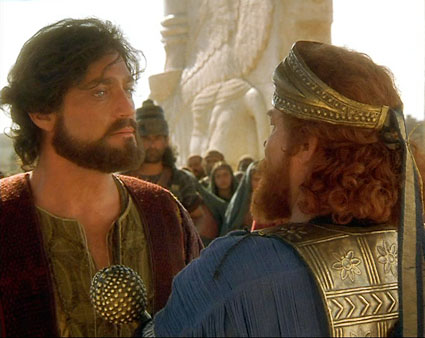
“…if the Lord creates something new, and the ground opens its mouth and swallows them up with all that belongs to them, and they go down alive into Sheol, then you shall know that these men have despised the Lord.” (Numbers 16:29-30)
Daughter Jerusalem kept up an outward show of respectability, but under her Temple veils and military skirts her legs were open for anyone. [1] In a vision, Ezekiel dug a hole through this wall of “whitewash” as a legal witness to her crimes against the Covenant.
Continue reading
Comments Off | tags: Compromise, Covenant curse, Ezekiel, Flood, Haman, Herod, Jeremiah, Revelation, Zedekiah | posted in Biblical Theology, The Last Days
Jan
5
2010
Understanding the Two Tables
Another thought on Jesus’ “joke” in Matthew 24. In Menu for the the Dirty Birds, I wrote:
“For wherever the carcass is, there the eagles will be gathered together.” Matthew 24:28
Tabernacles, as the final harvest of the year (grapes and olives), was also called “Ingathering.” Matthew 24 also follows the feast structure (twice), and Jesus uses this factor to make a terrifying joke.
As a holy priesthood, we are to be eaten by the world. But there are two Tables and we often confuse them.
Continue reading
Comments Off | tags: AD70, Communion, Feasts, Jewish war, Joke | posted in Biblical Theology, Christian Life, The Last Days
Jan
4
2010
or Collision II
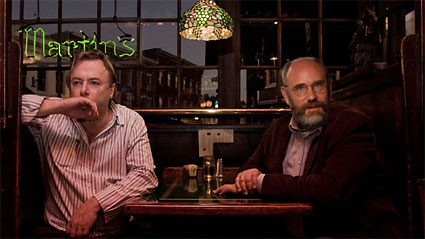
In the movie Collision, Christopher Hitchens relies a lot on the idea of a moral consensus, the idea that humanity has an innate sense of what’s right and what’s wrong and that we all agree on the basics. Is there any merit in this assumption? Or is Hitchens assuming that the benefits of Christianity are the result of human reason? Peter Leithart argues that Calvin, as an heir of 1200 years of Christendom, made exactly this mistake.
(I present below just the head and tail of Dr Leithart’s argument. I highly recommend getting a hold of the essay and reading his full argument and evidences.)
Excerpts from Did Plato Read Moses?
Peter Leithart on Middle Grace and Moral Consensus
The Bible presents a bleak view of the moral potential of the natural man. In this respect it seems to fly in the face of the facts. What are we to make of the empirical phenomenon of the “good pagan”?
Continue reading
10 comments | tags: C. S. Lewis, Calvin, Christopher Hitchens, Church History, Peter Leithart | posted in Apologetics, Biblical Theology, Ethics
Jan
3
2010
A Lesson for Modern Evangelicals

.
Not being from an oral communication/event-oriented culture, my recollection of the details of the following account might be a bit fluffy. But the story is true nonetheless.
Continue reading
Comments Off | tags: Gnosticism, Mission | posted in Biblical Theology, Christian Life